
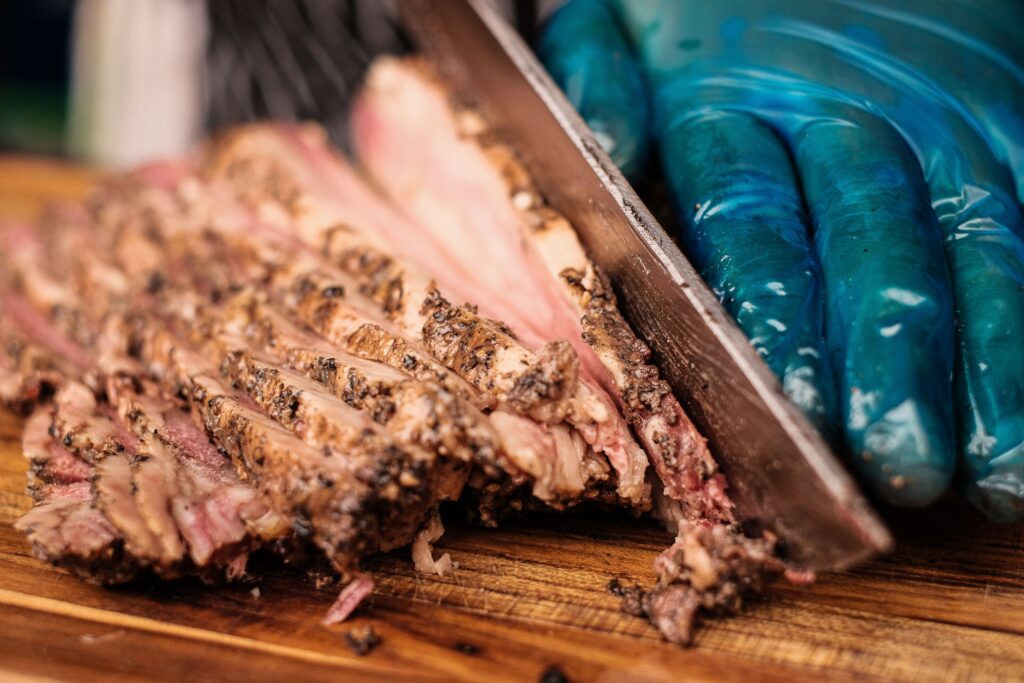
Beef Subprimal Flat Cut: Slow-Braised Until the Knife Becomes Optional
The brisket flat is a slab of beef that punishes impatience. It comes off a steer that has spent years moving its chest muscles to support its own weight — the result is dense, collagen-laced meat that starts the cooking process with the texture of a boot sole and ends it, given enough time and heat, as something close to silk. Get the temperature and time right, and you pull slices so tender they buckle under their own weight.
Part of the Beef Brisket primal → Beef Subprimal Flat Cut sub-primal.
Ingredients
- 4–5 lb beef brisket flat cut, fat cap intact (minimum ¼ inch)
- 2 tablespoons kosher salt
- 1 tablespoon coarse black pepper
- 1 tablespoon smoked paprika
- 1 teaspoon garlic powder
- 1 teaspoon onion powder
- ½ teaspoon cayenne pepper
- 2 tablespoons neutral oil (vegetable or avocado)
- 1 large yellow onion, roughly sliced
- 4 garlic cloves, smashed
- 2 cups beef stock
- 1 cup dry red wine (or additional beef stock)
- 2 sprigs fresh thyme
- 2 bay leaves
Instructions
- Remove the brisket flat from the refrigerator 1 hour before cooking. Pat every surface completely dry with paper towels — moisture on the surface will steam instead of sear.
- Combine the salt, black pepper, smoked paprika, garlic powder, onion powder, and cayenne in a small bowl. Rub the seasoning mixture over every surface of the meat, pressing it in firmly with your palms.
- Preheat your oven to 300°F (150°C).
- Heat the oil in a large Dutch oven over high heat until it shimmers and a wisp of smoke begins to rise.
- Place the brisket fat-side down in the pot, pressing it flat. Cook undisturbed for 4–5 minutes until a deep mahogany crust forms. Flip and sear the remaining sides, 2–3 minutes per side. Transfer the brisket to a plate.
- Reduce heat to medium. Add the sliced onion and cook, stirring occasionally, until softened and golden — about 6 minutes. Add the smashed garlic and cook for another 60 seconds.
- Pour in the red wine and scrape every browned bit from the bottom of the pot. Let the wine reduce by half, about 3 minutes.
- Add the beef stock, thyme, and bay leaves. Return the brisket to the pot, fat-side up. Liquid should reach halfway up the sides of the meat.
- Cover tightly and braise in the oven for 3½ to 4 hours, until a fork slides in and out without resistance and the internal temperature reads 195°F–205°F. Note: USDA minimum safe temperature for whole beef cuts is 145°F with a 3-minute rest, but brisket requires 195°F–205°F to convert collagen to gelatin and become tender.
- Remove from oven. Transfer the brisket to a cutting board, tent loosely with foil, and rest for at least 20 minutes.
- Skim fat from the braising liquid. Return the pot to medium-high heat and reduce the liquid until it coats the back of a spoon, 10–15 minutes. Remove thyme and bay leaves.
- Slice against the grain into ½-inch slices. Arrange on a platter and spoon the sauce over the top.
Why This Cut Works
The brisket flat is the larger and leaner of the two muscles that make up the brisket primal — the other half is the point cut, which rides on top and carries far more intramuscular fat. The flat sits in the chest region of the steer, a muscle that has supported the animal’s weight during every standing moment of its life. That kind of sustained load builds dense, fibrous muscle threaded with connective tissue — primarily collagen — and very little marbling compared to cuts from less-worked parts of the carcass like the rib or short loin.
That collagen is simultaneously the problem and the solution. At moderate temperatures — 145°F to 165°F — collagen contracts and squeezes moisture from the muscle fibers, making the meat drier and tougher as it heats. A brisket pulled at 160°F has lost moisture without yet converting its collagen. The real transformation happens between 190°F and 210°F, when Type I and Type III collagen hydrolyze into gelatin through prolonged moist heat. That gelatin coats the muscle fibers, fills the braising liquid with body and shine, and lubricates every slice. The fat cap — typically ¼ to ½ inch thick on the flat — renders during braising and bastes the upper surface, contributing additional moisture and flavoring the liquid below.
Because the flat contains less fat than the point cut, it holds its shape better after cooking. Texas-style smoked brisket presentations built around clean, intact slices almost always use the flat. The point cut tends to shred under its own weight and is typically cubed for burnt ends. Anyone who wants brisket that holds a defined slice on the plate should buy the flat.
Braising in red wine and beef stock serves mechanical functions beyond building flavor. The acidic wine begins to denature surface proteins before the heat has fully penetrated the meat — a chemical head start that shortens effective cooking time compared to stock alone. The liquid also maintains a humid environment inside the closed Dutch oven, preventing the surface from desiccating before the interior collagen finishes converting. A dry roast without liquid would require wrapping the flat in foil partway through to prevent the exterior from becoming jerky while the inside catches up.
How to Buy and Store This Cut
At a grocery store or butcher, the brisket flat is typically sold as a 3- to 7-pound cut already separated from the point. Some retailers trim the fat cap down to almost nothing to make the package look leaner — avoid those packages or ask the butcher to leave at least ¼ inch of fat cap intact. Without it, the top surface of the flat dries during braising and the rendered fat that would have basted the meat goes missing.
Look for deep red-purple color with no grayish patches. Gray discoloration signals oxidation, meaning the cut has been sitting exposed to air too long. The fat should be white or cream-colored and firm to the touch, not yellow or tacky. Loose packaging with pooled liquid inside indicates extended shelf time; tightly sealed cryovac packaging is a better sign of freshness. If buying from a wholesale club, whole briskets (flat and point together) run 12 to 16 pounds and can be separated at home by cutting through the fat seam between the two muscles.
Store the raw flat in the coldest part of your refrigerator between 35°F and 38°F and cook within 3 to 5 days of purchase. For longer storage, freeze in the original vacuum-sealed packaging for up to 6 months. Thaw in the refrigerator over 24 to 48 hours — not on the counter, where the surface enters the bacterial danger zone (40°F–140°F) long before the center thaws.
Leftover cooked brisket should be stored submerged in its braising liquid. Sliced flat reheated gently in liquid on the stovetop over low heat recovers remarkably close to its original texture. The same slices reheated dry in a microwave do not.