
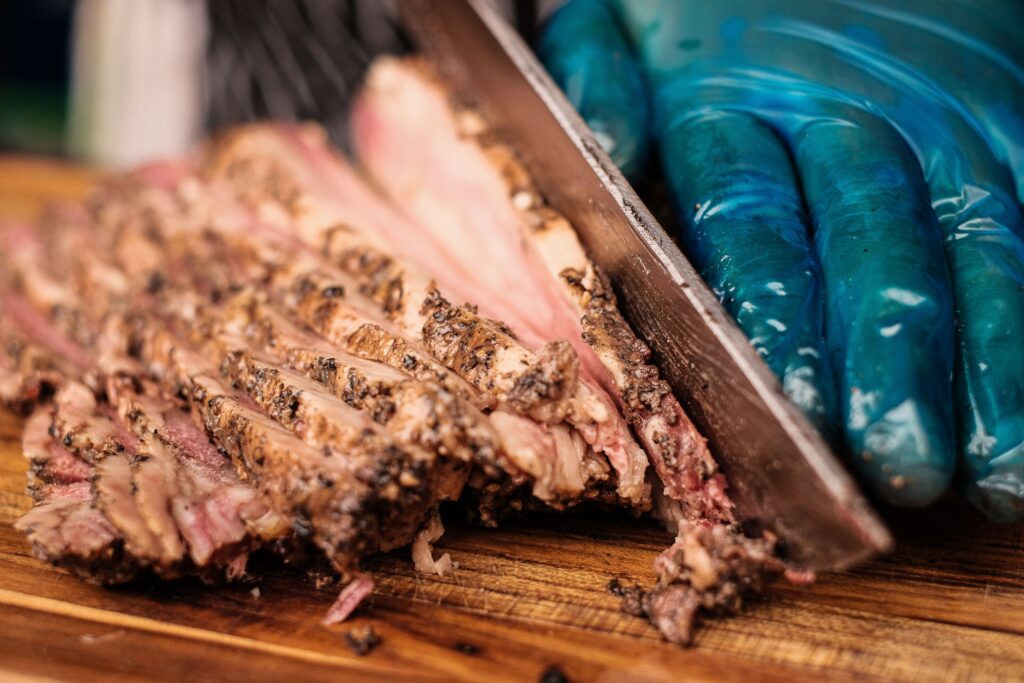
The flat cut is built for the long game — fourteen hours in the smoker, days in a brine, a Dutch oven left to work overnight. But freeze it for forty minutes, slice it against the grain to a quarter inch, and something changes: those tight, collagen-dense muscle fibers become exactly what a screaming-hot wok demands.
Part of the Brisket primal → Flat Cut sub-primal.
Ingredients
- 1½ lbs beef flat cut (brisket flat), partially frozen for easier slicing
- 3 tablespoons soy sauce (low-sodium works)
- 2 tablespoons oyster sauce
- 1 tablespoon Shaoxing rice wine (or dry sherry)
- 1 teaspoon toasted sesame oil
- 1½ teaspoons cornstarch
- 2 teaspoons sugar
- ½ teaspoon freshly cracked black pepper
- 3 tablespoons neutral oil (canola, avocado, or vegetable), divided
- 1 large red bell pepper, cut into ½-inch strips
- 1 medium yellow onion, sliced into thin half-moons
- 4 cloves garlic, thinly sliced
- 1½ tablespoons fresh ginger, grated
- 3 scallions, cut into 1½-inch pieces
- 1 teaspoon chili garlic sauce or sambal oelek (optional, for heat)
- Cooked jasmine rice, for serving
- Toasted sesame seeds, for garnish (optional)
Instructions
- Place the flat cut in the freezer for 30 to 45 minutes. It should be firm but not frozen solid — you want resistance under the knife, not a block of ice.
- Remove the meat from the freezer. Identify the direction of the grain — in the flat cut, muscle fibers run long and parallel down the length of the roast. Slice perpendicular to those fibers, cutting strips ⅛ to ¼ inch thick. If you slice with the grain, the meat will be tough regardless of how hot your pan gets.
- Combine soy sauce, oyster sauce, rice wine, sesame oil, cornstarch, sugar, and black pepper in a bowl. Whisk until the cornstarch is fully dissolved. Add the sliced beef, toss to coat thoroughly, and marinate at room temperature for 15 to 20 minutes.
- Set your wok or largest, heaviest skillet over the highest flame your stove can produce. Do not rush this. Let the pan heat for 2 to 3 full minutes until you see the first wisps of smoke rising from the metal.
- Add 2 tablespoons of neutral oil. Swirl to coat. When the oil shimmers and begins to smoke lightly, add half the marinated beef in a single layer. Do not stir. Let it sear undisturbed for 60 to 75 seconds until the bottom edges turn deep brown.
- Stir-fry the first batch for another 30 seconds until just cooked through, then transfer to a clean plate. Repeat with any remaining beef if needed, adding a touch more oil if the pan looks dry.
- With the pan still over high heat, add the remaining tablespoon of oil. Add the onion and bell pepper and cook, stirring frequently, for 2 minutes until they soften slightly but retain some texture.
- Add garlic and ginger. Stir constantly for 30 to 45 seconds — you want fragrant, not burnt.
- Return all the seared beef to the pan. Add scallions and the chili garlic sauce if using. Toss everything together over high heat for 60 seconds, letting the sauce coat the meat and vegetables and reduce slightly.
- Taste. Adjust with a few drops more soy sauce if it needs salt, or another pinch of sugar if it tastes flat.
- Serve immediately over jasmine rice. Because these are thin slices cooked at high heat, the beef will reach an internal temperature well above the USDA minimum of 145°F (63°C) rapidly — don’t hold them in the pan longer than needed or they’ll tighten up.
Why This Cut Works
The flat cut is the pectoralis profundus — the deep pectoral muscle that braces the front quarter of a steer against gravity all day. Constant, sustained load means densely packed muscle fibers and significant intramuscular connective tissue. This is precisely why the flat is the standard bearer for Texas-style brisket: hours of low heat convert that connective tissue into gelatin, yielding the glossy, sliceable slabs that people stand in line for.
But the same anatomy that demands patience in the smoker works to your advantage in the wok, provided you short-circuit the connective tissue problem mechanically. Slicing thin against the grain breaks those long muscle fibers into short segments that no longer require prolonged heat to become tender. The cornstarch in the marinade handles the rest — it forms a thin, protective coating on each slice that promotes rapid surface browning without overcooking the interior, a technique Chinese cooks call velveting. The process seals moisture inside the meat while still allowing the Maillard reaction to develop the crust that makes the stir-fry taste like something other than steamed beef. The flat cut also has pronounced, honest beef flavor from those worked muscles — more depth than flank steak, more presence than sirloin. That intensity holds up against the umami load of soy sauce and oyster sauce rather than getting buried under it. And because the flat is a large, typically affordable roast, you can buy it whole, slice what you need for the wok, and use the remainder for a weekend low-and-slow cook. This is a cut that rewards planning.
How to Buy and Store This Cut
The flat cut appears at the butcher counter or supermarket meat case labeled “brisket flat,” “first cut brisket,” “thin cut brisket,” or sometimes just “flat.” For stir-fry, look for a flat with visible marbling running through the muscle — a purely lean flat will be drier at high heat. The fat cap should be present but trimmed to roughly ¼ inch; anything thicker is fat you’re paying for and trimming off at home. Asian grocery stores frequently carry thinner, more marbled brisket flats ideal for quick-cooking applications. If you’re buying from a warehouse club or grocery chain, the flats tend to run larger and leaner — fine for the wok but better bought with the intention of slicing and freezing individual portions.
Store raw flat cut in the coldest part of your refrigerator and use within 3 to 4 days of purchase. To freeze, slice the meat against the grain as described, layer slices between parchment paper in a freezer bag, and press out as much air as possible before sealing. Frozen sliced flat cut thaws in the refrigerator overnight and is ready to marinate the next day. Cooked stir-fry keeps refrigerated for up to 3 days — reheat in a screaming-hot pan, not a microwave, if you want anything resembling the original texture. If you ask your butcher to run the flat through their meat slicer at 3mm, many will do it at no charge, and you’ll save the partial-freeze step entirely.