Dry Brined Turkey with Porcini Salt
Most dry brined turkey recipes say to use 3 tablespoons of kosher salt and leave it there. That can be off by nearly double: a spoonful of dense Morton carries close to twice the salt of light, hollow Diamond Crystal. We measure salt as a share of the bird’s weight instead, then give spoon amounts for both brands.
The other thing the top recipes skip is the gap between breast and leg. Breast meat is done at 155 to 160F. Thighs want 175F. A whole bird roasted straight from the fridge hands you one or the other. Our honest tip: lay a bag of ice on the breast for 30 minutes before it goes in the oven.
The addition that makes this one ours is dried porcini, ground to powder and rubbed in with the salt. It browns the skin a shade deeper and leaves a savory note in the drippings that carries straight into the gravy.
Why this recipe works
- Salt by weight. Grams and per pound amounts for both kosher salt brands.
- Uncovered rest. Fridge air dries the skin for one to three days, so it crisps instead of steaming.
- Porcini powder in the brine. Glutamates read as deep roasted flavor, and fine powder sticks where dried herbs fall off.
- The breast starts colder. Ice on the breast gives the thighs a head start so both finish together.
- A thermometer, not a clock. We pull on temperature at two spots and let carryover finish.
Which cut to buy for dry brined turkey
Buy a whole turkey of 12 to 14 lb (5.4 to 6.4 kg) labeled natural or minimally processed, with no added solution. Labels reading “self-basting”, “enhanced”, “kosher” or “contains up to 8 percent of a solution” mean the bird is already salted, and a dry brine on top gives the breast a ham-like texture.
Turkey is built like a large chicken, so our poultry cuts guide applies here too. The whole chicken anatomy page explains why the lean, thick breast and the working leg cook at different speeds. The chicken breast and chicken thigh pages cover the muscle differences behind our two target temperatures.
Good alternatives: two 10 to 12 lb birds instead of one 22 lb bird (faster and more even), or a bone-in breast. Our sous vide bone-in turkey breast takes this same dry brine. Avoid pre-basted birds and anything over 20 lb.
Ingredients
The turkey
- 1 whole natural turkey, 12 lb (5.4 kg), thawed, neck and giblets removed
Porcini dry brine
- 1/2 oz (15 g) dried porcini mushrooms
- 5 tablespoons (44 g) Diamond Crystal kosher salt, or 3 tablespoons (44 g) Morton kosher salt
- 1 tablespoon (13 g) light brown sugar
- 2 teaspoons (5 g) coarsely ground black pepper
- 1 tablespoon (3 g) dried thyme
For roasting
- 4 tablespoons (56 g) unsalted butter, melted
- 1 large onion (300 g), quartered
- 2 carrots (200 g), cut into chunks
- 2 celery ribs (100 g), cut into chunks
- 1 cup (240 ml) water or unsalted turkey stock
- 2 ice packs or two 1 qt (1 liter) bags of ice
Substitutions. For a different bird weight, use 3.6 g of salt per pound (8 g per kg) and scale the rest of the brine with it. Table salt works at the Morton amount. No porcini: use 2 tablespoons of dried mushroom powder from any blend, or leave it out and add 2 teaspoons of finely grated orange zest. Olive oil can replace the butter.
Method
1. Thaw the bird in the fridge
Allow about 24 hours for every 4 to 5 lb, so a 12 lb bird needs close to 3 days and a 20 lb bird about 5. Add 1 to 3 days of brining, so the frozen turkey goes into the fridge 5 to 6 days before you roast. Remove the neck and giblets, cut off any plastic leg clip and pat the bird dry.
2. Grind the porcini and mix the brine
Break the porcini into a spice grinder and blitz to a fine powder. Stir it with the salt, brown sugar, pepper and thyme in a bowl. Fine powder clings to the skin; flakes sit on top and burn.
3. Salt the turkey
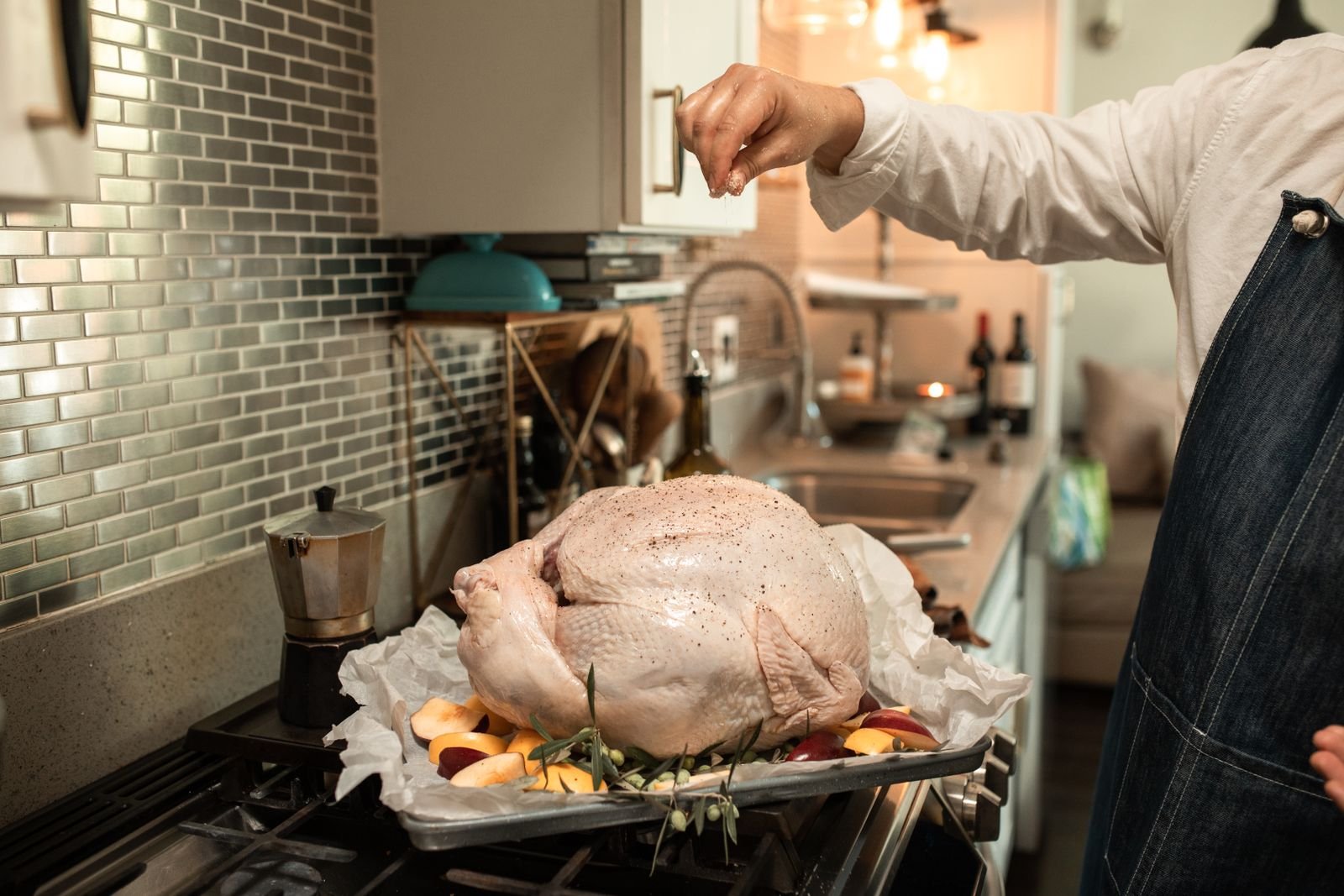
Set the turkey breast side up on a metal rack over a rimmed sheet pan. Work your fingers under the skin from the neck end to loosen it over both breasts and down toward the thighs, keeping it intact. Rub about a third of the brine directly onto the meat under the skin, put a spoonful in the cavity, then sprinkle the rest evenly over the outside.
4. Rest it uncovered for 1 to 3 days
Slide the pan onto the lowest shelf of the fridge, uncovered, for 24 to 72 hours. The salt draws out liquid, which is reabsorbed and loosens the proteins so they hold more juice. The open air dries the skin until it looks taut and slightly translucent.
5. Ice the breast and heat the oven
Take the turkey out of the fridge about 45 minutes before roasting. Lay the ice packs over the breast (a reusable silicone bag of ice works if you want to skip single-use plastic) and leave the legs uncovered. Heat the oven to 450F with a rack in the lower third. The breast stays cold while the legs warm.
6. Roast hot, then low
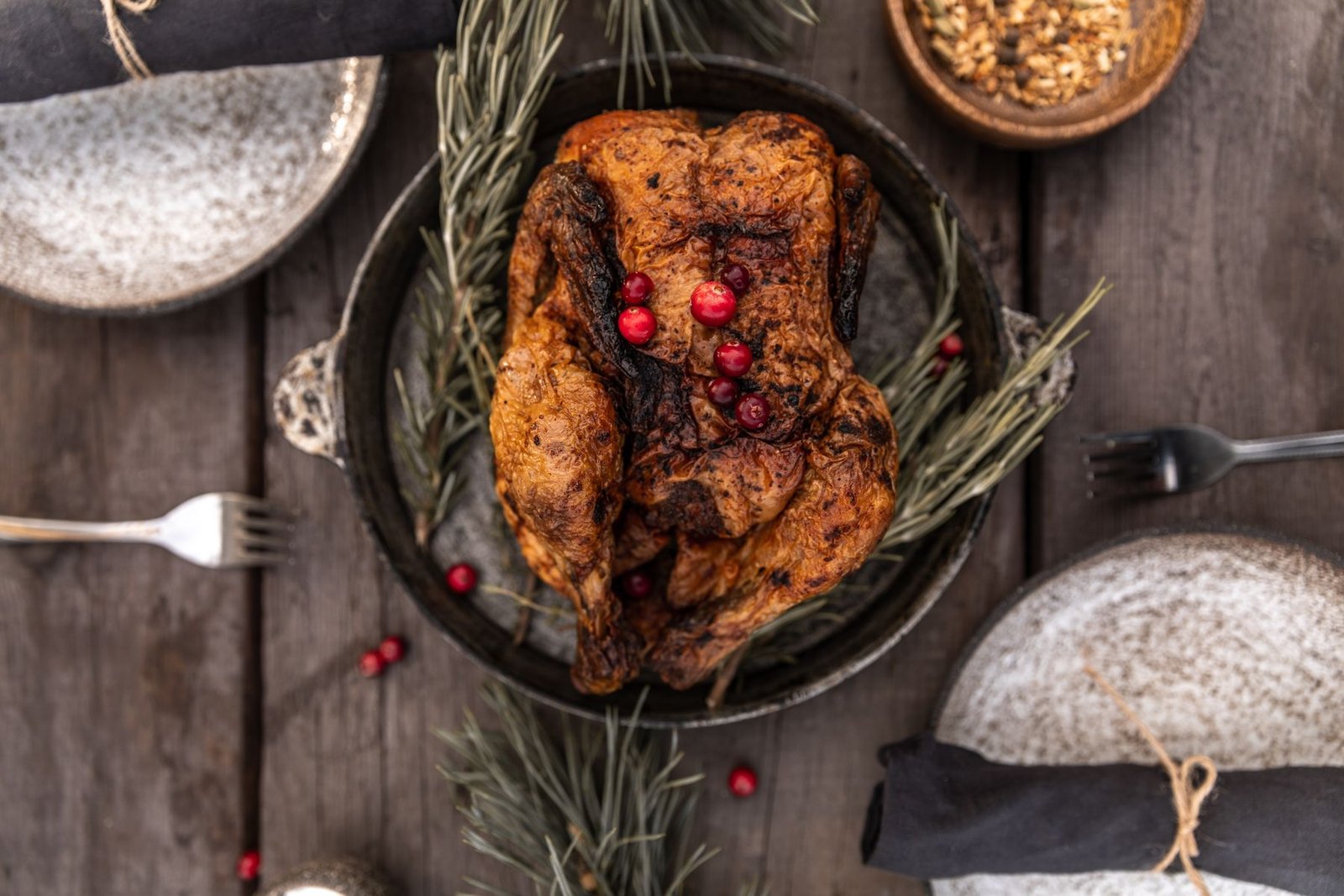
Scatter the vegetables in a heavy roasting pan with the water, set the turkey on a metal rack above them, and brush with the melted butter. Roast at 450F for 30 minutes to set the color, then lower to 325F. For a 12 lb bird, expect another 1 3/4 to 2 1/4 hours. Pull at 155 to 160F deep in the breast and 175F or higher in the thickest part of the thigh, away from bone. If the skin darkens before the meat is ready, tent the breast loosely with foil.
7. Rest and carve
Move the turkey to a cutting board and rest it uncovered for 30 to 40 minutes. Carryover lifts the breast to 160 to 165F, and leaving it uncovered keeps the skin crisp. Make gravy from the drippings meanwhile. Remove each breast half whole and slice it across the grain on a wooden board.
Salt by weight: Diamond Crystal versus Morton
Diamond Crystal forms hollow, pyramid shaped flakes. Morton is rolled into dense, flat crystals. By volume, a teaspoon of Diamond Crystal weighs about 2.8 g and a teaspoon of Morton about 4.8 g. A recipe without a brand is a coin toss.
We work from weight. For poultry we like about 0.8 percent of the raw bird’s weight in salt. That is 3.6 g per pound, or 44 g for a 12 lb turkey. In spoons:
- Diamond Crystal: about 1 1/4 teaspoons per pound, 5 tablespoons for 12 lb
- Morton kosher: about 3/4 teaspoon per pound, 3 tablespoons for 12 lb
- Enhanced or kosher bird: half the amount, or none on the outside
At 1 percent the bird is still good, just saltier. A cheap digital scale settles the question for good.
Closing the gap between breast and leg
A whole turkey asks two muscles to finish at the same time when they want different things. The breast is lean and turns dry and stringy past about 165F. The thighs and drumsticks carry connective tissue that only softens around 175 to 180F. Cook for the thighs and the breast overshoots. Cook for the breast and the joints stay rubbery.
The ice pack trick is the lowest effort fix. Starting the breast 10 to 15 degrees colder than the legs means it reaches 155F about when the thighs hit 175F. Check both spots with a fast thermometer; we use a Thermapen, and our meat thermometer guide covers leave-in probes too.
The bigger fix is spatchcocking. Cut out the backbone, press the bird flat, and the legs sit out at the hot edges of the pan while the breast lies in the middle. A 12 lb spatchcocked turkey roasts at 425F in about 80 to 90 minutes. It is the method from our spatchcock chicken, scaled up with heavier shears. Salt it flat on the rack and the skin dries even faster. For the roasting basics behind both approaches, see our roasting guide.
Heritage and pasture raised turkeys cook differently
Most supermarket turkeys are Broad Breasted Whites, bred for a heavy breast and raised quickly indoors. Heritage breeds such as Bourbon Red, and pasture raised birds of any breed, walk and forage. They have a leaner breast, longer legs and less fat under the skin.
That changes the cook. With less fat insulating the breast, a heritage bird runs ahead of a commercial one of the same weight, often by 30 minutes or more on a 12 lb turkey. We cut the salt slightly, to about 0.7 percent, because the leaner breast takes it up faster. We still use the ice packs, and we pull the breast at the low end of the range, 155F. The legs are the prize, and they benefit from reaching 180F.
Brush with a little more butter, since there is less fat under the skin. The stronger flavor pairs well with porcini. You can find these birds through farms on our poultry hub.
Pro tips and common mistakes
- Do not cover the bird in the fridge. Plastic wrap traps moisture and undoes the skin drying.
- Do not add salt again. Use unsalted butter and stock, and taste the gravy first.
- Skip the basting. It drops the oven temperature and wets the skin.
- Do not stuff the cavity. It slows the thighs. Bake it separately.
- Use metal and wood. A metal rack, a metal or heavy enameled pan and a wooden carving board keep plastic away from hot fat.
Troubleshooting
Symptom: The meat tastes salty or the breast is springy like ham. Cause: Morton salt measured at a Diamond Crystal amount, or a pre-salted bird. Fix: Weigh the salt next time and check the label.
Symptom: Pale, rubbery skin. Cause: The bird was covered in the fridge, or the oven was too cool at the start. Fix: Rest uncovered for at least 24 hours and start at 450F.
Symptom: Breast is dry while the thighs are just done. Cause: The two finished at different times. Fix: Use the ice packs or spatchcock. Rescue a dry breast with warm gravy.
Symptom: Skin is blackened in patches. Cause: Sugar and porcini on exposed areas at high heat. Fix: Tent the breast with foil once it is deep mahogany, and skip the sugar if you roast hotter than 450F.
Storage and leftovers
Carve all the meat off the frame within 2 hours of roasting and refrigerate it in a covered glass or steel container for up to 4 days. To reheat, put slices in a covered dish with a splash of stock and warm at 300F until they reach 165F, about 15 to 20 minutes. It freezes for 3 months under a little gravy. Simmer the carcass for stock.
What to serve with dry brined turkey
- Porcini pan gravy. Whisk the drippings with flour and stock; the mushroom powder in the brine is already in the pan.
- Roasted root vegetables. Parsnips and carrots roast while the turkey rests.
- Sharp cranberry sauce. Tart fruit cuts the rich dark meat.
- Bread stuffing baked in a pan. Crisp edges and no food safety worries about the cavity.
Nutrition (estimate per serving, 12 servings): 450 calories, 56 g protein, 23 g fat, 2 g carbohydrate. Estimated from the ingredient list and yield, not a lab value.
Frequently asked questions
How much salt do I need to dry brine a turkey?
About 0.8 percent of the bird’s weight, or 44 g for a 12 lb turkey. That is roughly 1 1/4 teaspoons of Diamond Crystal or 3/4 teaspoon of Morton per pound.
Do I rinse the dry brine off before roasting?
No. The salt has been absorbed and the dry surface is what you want. Rinsing wets the skin and spreads raw poultry juices around your sink.
Can I dry brine a self-basting or kosher turkey?
Only with half the salt or less. Kosher birds are salted during processing and self-basting birds are injected with a salt solution, so a full dry brine leaves the meat spongy.
How long can a turkey dry brine in the fridge?
Anywhere from 24 to 72 hours. Two days is our sweet spot. Past three days the breast surface starts to taste cured.
Can I dry brine a turkey that is still partly frozen?
Salt will not move into frozen meat. Wait until the cavity is free of ice and the thighs flex, or salt the thawed exterior now and add the under-skin portion later.
Where to buy the meat
Look for a whole natural turkey with nothing injected, ideally a pasture raised or heritage bird ordered ahead from a local farm. Use our Find a Farmer directory to locate poultry producers near you, and ask whether the bird is sold fresh or frozen so you can plan the thaw.