Beef Wellington with Porcini Duxelles
Most beef wellington recipes tell you to bake for 25 minutes and hope. The trouble is that a 2 1/2 pound tenderloin wrapped in mushrooms, ham and pastry can’t be judged by color, and the pastry hides every clue. Clocks fail. A probe thermometer does not.
Our honest tip up front: pull the wellington at 120F in the center and let it rest 15 minutes. It coasts to medium rare under its pastry jacket. Pull it at 130F and you’ll slice into gray.
We build the duxelles with dried porcini as well as fresh cremini. Their soaking liquid goes back into the pan too. The rest is technique: a quick sear, a cold wrap and a hot baking sheet underneath.
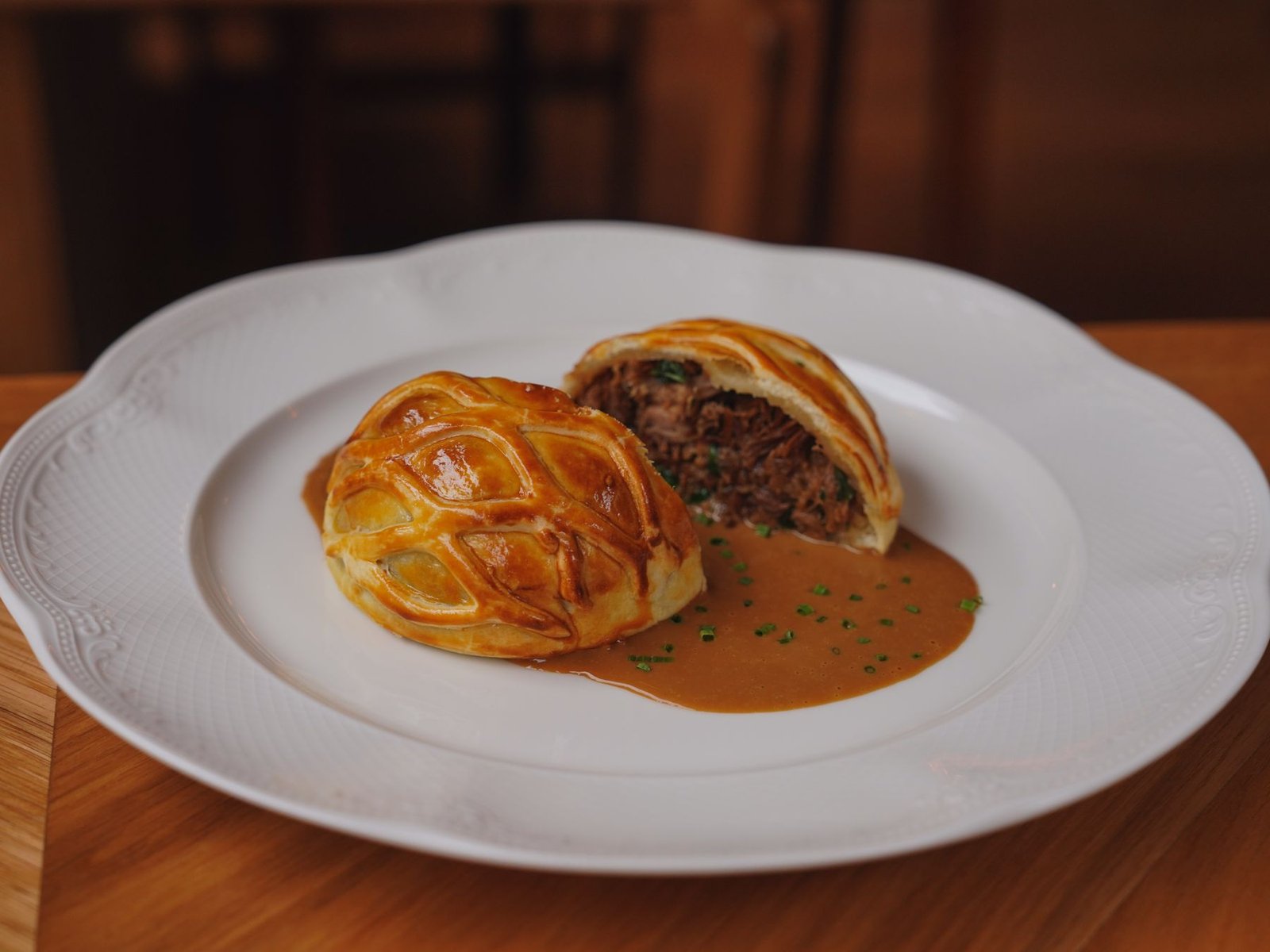
Why this recipe works
- A real pull temperature. We give you a number for each doneness and account for carryover under pastry, which runs higher than a bare roast.
- Porcini in the duxelles. Dried porcini and their soaking liquid deepen the mushroom layer so it tastes like more than wet cremini.
- A preheated sheet. Baking on a hot sheet on the lowest rack sets the bottom crust before the juices reach it.
- Grass fed timing. Leaner tenderloin cooks faster, and we tell you how much earlier to check.
Which cut to buy for beef wellington
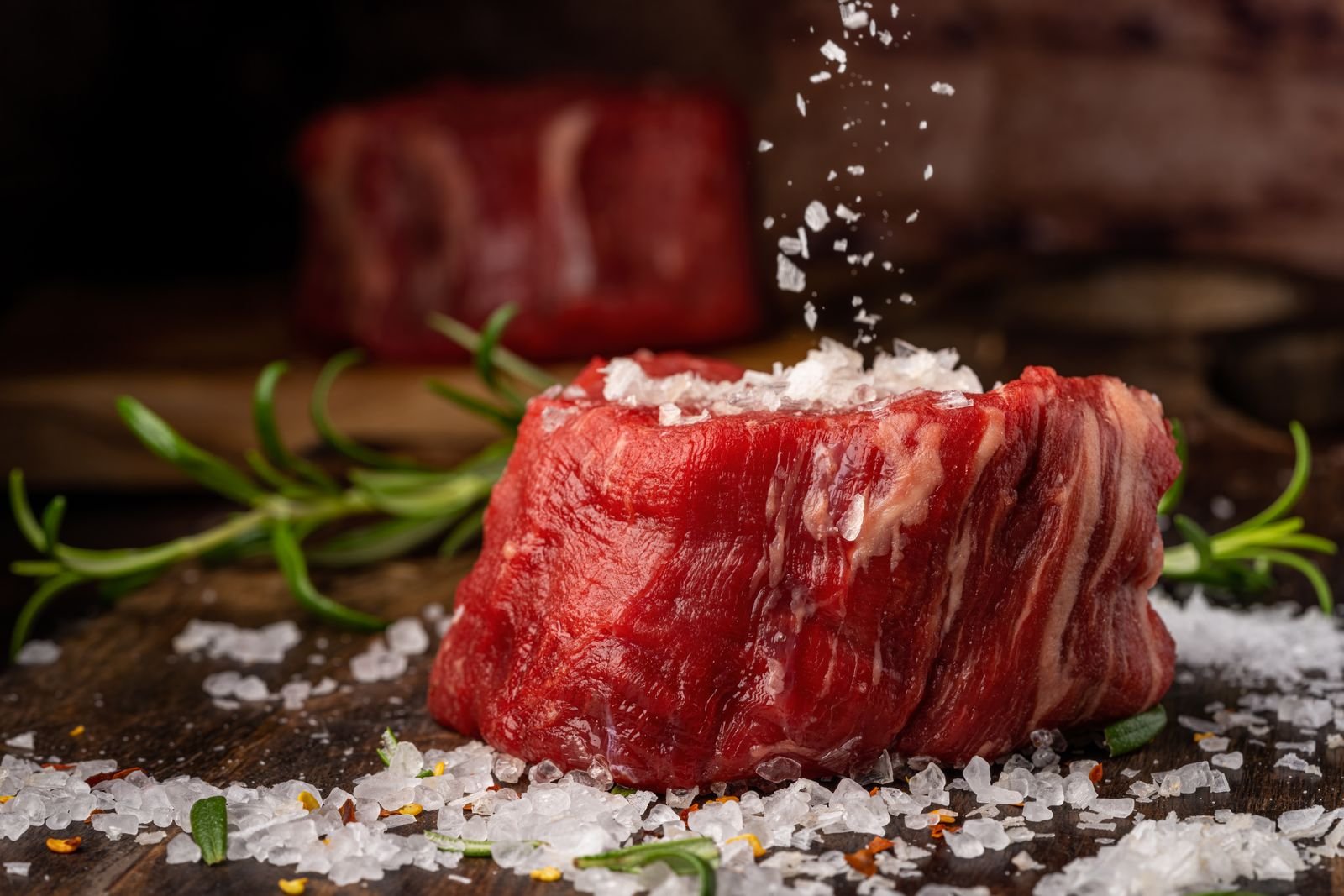
Buy the center-cut beef tenderloin, often sold as chateaubriand. It is the even, cylindrical middle of the muscle, about 3 1/2 to 4 inches across, and 2 1/2 lb (1.1 kg) feeds six. The even thickness is the whole point.
A whole tenderloin from the beef loin costs less per pound, and it is a fine buy if you are willing to trim. Cut off the side chain and the silverskin, then cut off the thick head and keep the center. If you want to use the tapered tail, fold it back under itself and tie it so the roast is an even thickness, but know that the tucked end often cooks a few degrees behind. We’d rather save the tail for a stir fry.
Avoid eye of round, which is too lean and turns tight at medium rare, and any “tenderloin roast” made of trimmings tied together. Our beef guide maps every primal.
Ingredients
For the beef
- 2 1/2 lb (1.1 kg) center-cut beef tenderloin (chateaubriand), trimmed of silverskin
- 2 teaspoons (10 g) kosher salt
- 1 teaspoon (3 g) black pepper, coarsely ground
- 1 tablespoon (15 ml) neutral oil with a high smoke point
- 1 1/2 tablespoons (25 g) Dijon mustard
For the porcini duxelles
- 1/2 oz (15 g) dried porcini
- 1/2 cup (120 ml) hot water
- 1 1/2 lb (680 g) cremini mushrooms
- 3 tablespoons (42 g) unsalted butter
- 2 shallots (80 g), finely chopped
- 2 garlic cloves, minced
- 2 teaspoons (2 g) fresh thyme leaves
- 1/4 cup (60 ml) Madeira or dry sherry
- 1/2 teaspoon (3 g) fine salt
For the wrap
- 8 thin slices (4 oz / 115 g) prosciutto
- 14 oz (400 g) all-butter puff pastry, thawed in the fridge
- 1 large egg plus 1 yolk, beaten with 1 teaspoon (5 ml) water
- 1/2 teaspoon (2 g) flaky salt
Substitutions. Dry sherry or a dry Marsala can replace Madeira. If you avoid pork, swap the prosciutto for two thin crepes (1 egg, 1/3 cup or 80 ml milk, 1/4 cup or 30 g flour). Any dried mushroom works in place of porcini, but porcini give the deepest flavor per gram. Skip puff pastry made with shortening, which bakes pale.
Method
1. Salt the tenderloin a day ahead
Tie the trimmed center cut at 1 inch intervals so it holds a round shape, salt it evenly with 2 teaspoons (10 g) kosher salt, and leave it uncovered on a rack in the fridge for 12 to 24 hours. The salt seasons deep into the meat and the dry surface sears faster, which matters because the sear has to be quick.
2. Make the porcini duxelles
Soak the porcini in 1/2 cup (120 ml) hot water for 20 minutes, squeeze them dry, and chop them fine. Pulse the cremini in batches to the size of coarse couscous. Melt the butter in a wide skillet over medium heat, soften the shallots and garlic for 4 minutes, then add the cremini, porcini and thyme. Stir with a wooden spoon until the pan is dry and the mixture sizzles, 25 to 30 minutes. Add the Madeira and strained porcini liquid and cook until both are gone. Chill the duxelles on a plate until cold.
3. Sear and chill the beef
Heat the oil in a cast iron skillet until it shimmers and sear the beef for 45 to 60 seconds per side, ends included. You want color, not cooking: the center should stay below 60F. Cut the string, brush with Dijon, and chill 20 minutes.
4. Wrap in prosciutto and chill
Shingle the prosciutto in two overlapping rows on a sheet of plastic wrap and spread the cold duxelles over it 1/4 inch thick. Set the beef on the near edge, roll it up tight using the wrap, and twist the ends. Chill at least 30 minutes so the log firms up.
5. Wrap in pastry and chill again
Roll the puff pastry on a floured board to about 12 by 14 inches (30 by 35 cm) and 1/8 inch thick. Unwrap the beef, set it on the pastry, brush the edges with egg wash, and roll it so the seam overlaps by 1 inch and sits underneath. Fold the ends like a gift, trimming excess dough so the ends are not more than two layers thick. Brush with egg wash, score a shallow crosshatch, add flaky salt, and chill 30 minutes.
6. Bake to temperature
Heat the oven to 425F with a heavy baking sheet on the lowest rack for 30 minutes. Brush the pastry with egg wash one more time, slide the wellington on its parchment onto the hot sheet, and bake 35 to 45 minutes. Start checking at 30 minutes. Pull it when the center of the beef reads 120F for medium rare, 128F for medium.
7. Rest and slice
Rest the wellington uncovered on the sheet for 15 minutes. The center will rise 8 to 10 degrees. Slice it into 1 1/2 inch slabs with a long serrated knife, using a gentle sawing motion so the pastry does not crush.
Why porcini belong in the duxelles
Classic duxelles is just minced mushrooms, shallot and butter cooked dry. Cremini are mostly water, and little flavor remains once it cooks off. Dried porcini fix this. Drying concentrates their glutamates, so a half ounce adds more savory depth than another pound of fresh mushrooms would.
The soaking liquid matters as much as the mushrooms. Strain it through a paper towel or fine metal sieve to catch grit, then add it to the pan after the cremini are dry. It reduces in a few minutes and leaves a brown, glossy coating on every bit of mushroom.
We lean on porcini across the site for this reason. The same idea runs through our porcini red wine pot roast and the compound butter on our bison steak with porcini butter. Chop the soaked porcini finer than the cremini so no one bites into a chewy piece.
Pull temperatures and carryover under pastry
A bare roast typically climbs 5 to 7 degrees after it leaves the oven. A wellington climbs more, often 8 to 10, because the pastry and duxelles hold heat around the beef like insulation.
Use these pull numbers, measured in the thickest part of the beef with an instant read probe. Our picks for a fast, accurate probe are in our meat thermometer guide; we use a Thermapen.
- Rare: pull at 112 to 115F, rests to about 122F.
- Medium rare: pull at 120F, rests to about 130F.
- Medium: pull at 128F, rests to about 137F.
Grass fed tenderloin changes the timing. It carries less intramuscular fat, so heat moves through it faster and there is less fat to buffer the edges. A grass fed center cut often hits 120F 5 to 8 minutes before a grain finished one of the same size. Check early. Our roasting guide covers carryover for other large cuts.
How to prevent a soggy bottom
A soggy bottom is the most common wellington failure, and it has three sources you can control. The first is wet duxelles. If the mushrooms still release liquid when you press them with a spoon, keep cooking. The second is meat juice. A brief sear in a hot pan (see our pan searing guide) and a full chill keep the beef from purging into the wrap before the pastry sets.
The third is heat from below. Pastry on a cold sheet takes too long to set on the bottom, so the top browns while the base stays raw. A heavy baking sheet preheated on the lowest rack for 30 minutes fixes this.
The prosciutto layer is your insurance. It sits between the duxelles and the pastry and soaks up whatever moisture escapes. A thin crepe does the same job, and you can use both.
The tight roll is the one place we use plastic wrap, since parchment can’t make a snug log. Keep contact short and cold, or use a reusable food-grade silicone wrap.
Pro tips and common mistakes
- Don’t skip the chills. Every chill firms the butter in the pastry and stops the beef cooking from the outside in.
- Keep the ends thin. Trim folded pastry so the ends are no more than two layers thick, or they stay raw.
- Score, don’t cut. Use the back of the knife for the pattern. A cut through the pastry lets steam escape and the crust splits.
- Sear hard and short. A well heated cast iron skillet browns the outside in under a minute per side. Longer than that and you cook a gray band.
Troubleshooting
Symptom: The pastry is brown on top but raw and pale underneath. Cause: The sheet was cold, or the duxelles was wet. Fix: Preheat a heavy sheet on the lowest rack and cook the duxelles until it sizzles.
Symptom: A thick gray ring around a pink center. Cause: The sear ran too long or the beef went into the oven warm. Fix: Sear under a minute per side and chill the wrapped log until cold through.
Symptom: The pastry browned before the beef reached temperature. Cause: The oven runs hot or the roast is thicker than 4 inches. Fix: Tent the top loosely with foil and keep baking to 120F.
Storage and leftovers
Refrigerate leftover slices in an airtight glass container for up to 3 days. The pastry softens in the fridge, so reheat slices on a rack in a 300F oven for 12 to 15 minutes, until the center reaches 110F. Skip the microwave. Make the duxelles up to 3 days ahead if you like.
What to serve with beef wellington
- A red wine pan sauce made with beef stock and the last of the porcini liquid.
- Roasted carrots with thyme, which share the oven while the wellington rests.
- Buttered green beans or charred broccolini for something green and crisp.
- Duck fat roast potatoes.
Nutrition (estimate per serving, 6 servings): 890 calories, 55 g protein, 55 g fat, 40 g carbohydrate. Estimated from the ingredient list and yield, not a lab value.
Frequently asked questions
What temperature should I pull beef wellington for medium rare?
Pull it when a probe in the thickest part of the beef reads 120F, then rest it 15 minutes uncovered. The pastry holds heat like a jacket, so the center climbs another 8 to 10 degrees and lands near 130F.
Can I make beef wellington the day before?
Yes. Assemble it fully, wrap it in pastry, and refrigerate it seam side down for up to 24 hours. Add 5 to 10 minutes to the bake and trust the thermometer, not the clock.
Do I have to use prosciutto?
No. A thin crepe does the same job as a moisture barrier, and some cooks use both. Without either one, the duxelles soaks straight into the pastry and the bottom turns pale and wet.
Why did my beef wellington come out gray all the way through?
The beef went into the oven warm, or it baked past 125F before resting. Chill the wrapped log until it is cold to the touch, and pull it at 120F. Carryover does the rest.
Is grass fed tenderloin good for beef wellington?
It is excellent, but it carries less marbling and cooks faster. Start checking the internal temperature 5 to 8 minutes earlier than you would with grain finished beef, and keep the sear short.
Where to buy the meat
Ask a butcher or a direct farm seller for a 2 1/2 lb center-cut beef tenderloin, trimmed, or a whole peeled tenderloin you can trim yourself. Grass fed and pasture raised beef from a local farm is worth the effort here, since the tenderloin is the star. Use our Find a Farmer directory to source beef near you, and check the meat price tracker before you buy.