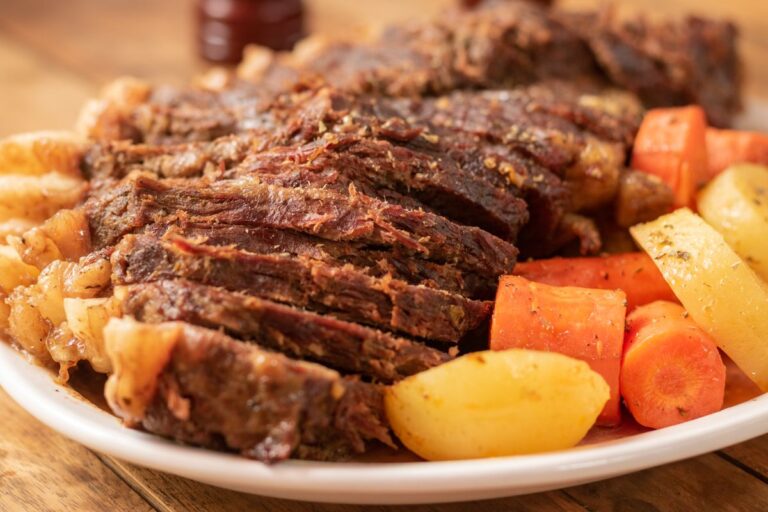
Reverse Seared Tri Tip Roast with Pickled Chili Santa Maria Salsa
Most tri tip roast recipes skip the step that decides tender or tough. The grain on this cut runs two ways, and if you slice straight down the length of the roast, half your plate is chewy. We split it at the grain change first, then slice each piece on its own.
The other common problem is a hot oven. A roast at 400 to 425F turns the outer half inch gray before the center is ready. We roast at 250F to 115F inside, then sear hard in cast iron and pull at 125 to 128F. Trust a probe, not a clock.
The hero here is the salsa. Santa Maria style salsa is tomato, onion and celery with a hit of chili, and we build it on pickled jalapeños and a spoon of their brine. The vinegar cuts the beef fat.
Why this recipe works
- Two grains, two cuts. Split where the fibers turn, so every slice crosses the grain.
- Low oven, short sear. A 250F oven then a hot skillet leaves almost no gray band.
- Real target temperatures. Oven target, pull point and rested temperature, not a timer.
- Acid built into the condiment. Pickled chili brine does a marinade’s job without a mushy surface.
- Dry brine, no sugar. No sugar in the rub means nothing burns in the skillet.
Which cut to buy for tri tip roast
Tri tip is the bottom sirloin, a triangular muscle (the tensor fasciae latae) from the lower part of the sirloin where the beef loin primal meets the round. Each side of beef has one, so a whole tri tip weighs only 1 1/2 to 3 lb. Its fibers fan out from the thick end, which causes the two grain directions.
Buy a whole, untrimmed tri tip of 2 to 3 lb with a thin fat cap. If you cannot find one, a thick piece of top sirloin butt cooks the same way with one grain direction and is our first substitute. Avoid thin tri tip steaks; pre-marinated packs are often injected with brine and sear poorly. Our beef cut guide shows where the whole sirloin sits on the animal.
Ingredients
For the tri tip
- 1 whole tri tip, 2 1/2 lb (1.1 kg)
- 2 1/2 teaspoons (8 g) Diamond Crystal kosher salt, or 1 1/4 teaspoons (7 g) fine sea salt
- 2 teaspoons (4 g) coarse ground black pepper
- 1 teaspoon (3 g) garlic powder
- 1 tablespoon (15 ml) beef tallow or avocado oil
For the pickled chili Santa Maria salsa
- 3 Roma tomatoes, 12 oz (340 g), diced
- 1/2 small white onion, 2 1/2 oz (75 g), finely diced
- 1 celery stalk, 1 1/2 oz (40 g), finely diced
- 2 tablespoons (30 g) pickled jalapeños, minced, plus 1 tablespoon (15 ml) of their brine
- 2 tablespoons (30 ml) lime juice
- 1 tablespoon (15 ml) extra virgin olive oil
- 1 teaspoon (5 ml) Worcestershire sauce
- 1/4 cup (10 g) chopped cilantro
- 1/4 teaspoon (1 g) fine sea salt
Substitutions: Pickled serranos or the brine from a jar of dill pickles work in place of the jalapeños. Ghee works for searing.
Method
1. Trim and dry brine
Trim the fat cap to 1/8 inch (3 mm) and remove silver skin. Coat every face with the mixed salt, pepper and garlic powder, then chill it uncovered on a wire rack for 4 to 24 hours. Salt needs 4 hours to work inward, and a dry surface browns faster later.
2. Make the pickled chili Santa Maria salsa
Dice the vegetables to 1/4 inch (6 mm) and stir everything together. Let it sit 30 minutes so the onion softens and the tomato juice forms a loose dressing.
3. Slow roast at 250F
Heat the oven to 250F (120C). Roast the tri tip on its rack with a probe in the thickest part of the wide end until it reads 115F (46C), usually 50 to 70 minutes. The thin end runs about 10F ahead, which gives medium slices for anyone who wants them.
4. Heat the cast iron
Heat a 12 inch Lodge cast iron skillet over medium high for 5 to 6 minutes, until a drop of water skitters and vanishes. Pat the roast dry. It can wait 10 minutes, since a slow roast carries little heat.
5. Sear hard and fast
Add the tallow or oil to the skillet. Sear fat side down for 60 to 90 seconds, then turn every minute. Pull at 125 to 128F (52 to 53C) for medium rare, 4 to 6 minutes in all.
6. Rest, split and slice
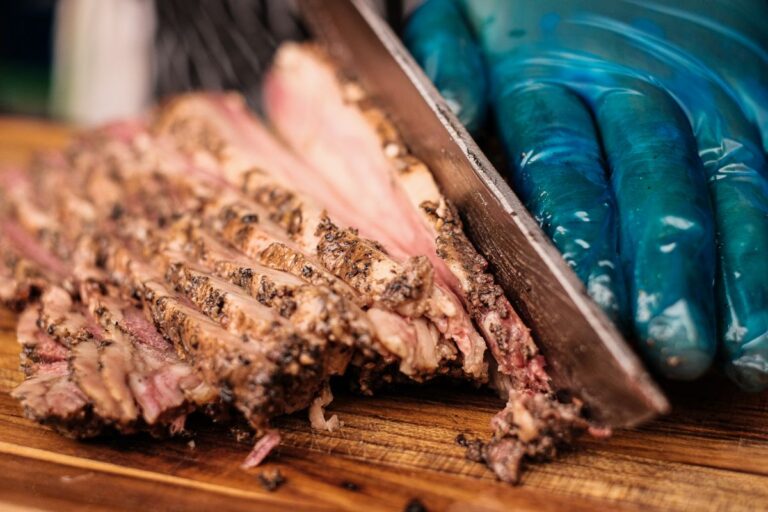
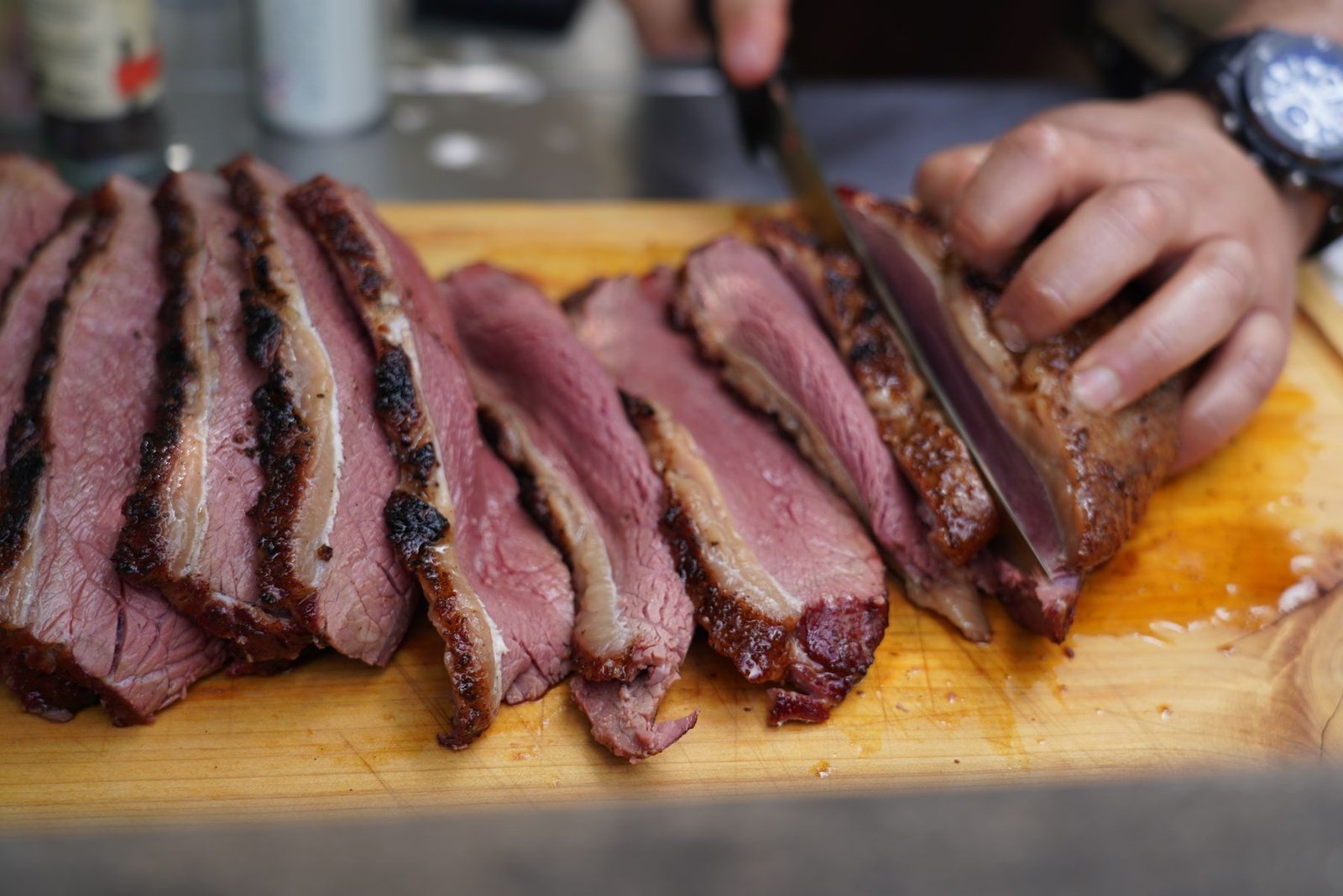
Rest 10 minutes on a wooden board; it climbs 2 to 3F to about 130F. Cut the roast in two where the grain changes, then slice each piece across its own grain at 1/4 inch (6 mm). Serve with the salsa.
How to slice tri tip with two grain directions
On a raw tri tip the fibers fan out from the wide end like the veins of a leaf. Where the triangle bends, the fibers on the thin arm run one way and those on the wide end run 45 to 90 degrees off them. The line is hard to see once crusted, so we nick the fat cap there before cooking.
After the rest, cut straight through the roast at that mark. You now have two pieces. Turn each one so its fibers run left to right in front of you, then slice top to bottom at 1/4 inch. Short fibers mean a tender bite. A long carving knife and a heavy wooden cutting board with a juice groove make this easier than a short chef’s knife on plastic.
Why reverse sear beats searing first on tri tip
The reverse sear method is not a convenience trick here. Tri tip is 1 1/2 to 2 1/2 inches thick at the wide end and under an inch at the tip. A hot oven overcooks the thin end and the outer half inch before the center is ready. At 250F that gap narrows.
Low heat also dries the surface, so a Lodge skillet browns it in 4 to 6 minutes instead of 10, with less overcooking under the crust. The cost is an hour and a probe. We use a Thermapen for spot checks plus a leave-in probe, and our meat thermometer reviews cover both. See also our guide to roasting meat.
Grass fed tri tip: smaller, leaner and faster
Grass fed tri tip from a pasture raised steer is usually 1 1/2 to 2 lb, against 2 1/2 to 3 lb from a feedlot animal. Its fat cap is thinner, so trim little or none.
Lean meat heats faster, so a grass fed roast can reach 115F in 35 to 50 minutes at 250F. Start checking at 30. Pull it from the skillet at the low end of our range, 125F, because lean beef tastes drier at 135F than grain finished beef at the same temperature. Sear time stays the same. Its stronger mineral flavor stands up to the pickled chili salsa, so we keep the rub plain.
Pro tips and common mistakes
- Mark the grain before cooking. A small nick in the fat cap at the grain change saves guessing on a crusted roast.
- Leave a thin fat cap. Trim to 1/8 inch. Thicker fat will not render in a short sear and eats rubbery.
- Probe the wide end. The tip reads 10F high.
- Use metal tongs. Plastic tongs soften in a hot skillet, and our non-plastic kitchen utensils list has sturdy steel and wood options.
Troubleshooting
Symptom: Slices are chewy and stringy. Cause: Half the roast was cut with the grain. Fix: Split the roast at the grain change and slice each piece across its own fibers.
Symptom: A wide gray band under the crust. Cause: The oven was too hot or the sear ran too long. Fix: Roast at 250F and keep the sear to 4 to 6 minutes total.
Symptom: Crust is pale and patchy. Cause: A wet surface or a skillet that was not hot enough. Fix: Pat the roast dry and preheat the cast iron for a full 5 minutes.
Storage and leftovers
Chill leftovers unsliced for up to 4 days. Store the salsa separately for up to 2 days. Warm slices in a 250F oven for 10 minutes so they stay pink, or slice cold for sandwiches.
What to serve with tri tip roast
- Santa Maria pinquito beans.
- Garlic bread toasted in the skillet after the sear.
- A green salad with a mustard vinaigrette.
- Roasted potatoes.
Nutrition (estimate per serving, 6 servings): 405 calories, 39 g protein, 26 g fat, 5 g carbohydrate. Estimated from the ingredient list and yield, not a lab value.
Frequently asked questions
Is tri tip a roast or a steak?
Both. A whole tri tip cooks like a small roast and carves into steak-like slices.
What temperature should I pull tri tip for medium rare?
Roast to 115F, then pull from the skillet at 125 to 128F. It rests up to about 130F.
Why is my tri tip chewy even though I cooked it right?
The grain runs two ways, so slicing the whole roast in one direction leaves half the slices with the grain. Split it at the grain change first.
Should I cover tri tip with foil while it rests?
No. A reverse seared roast carries little heat, and foil traps steam that softens the crust.
Can I cook a frozen tri tip?
You can roast it from frozen at 250F, adding 30 to 45 minutes. We prefer thawing it in the fridge for 24 to 36 hours so the dry brine can work.
Where to buy the meat
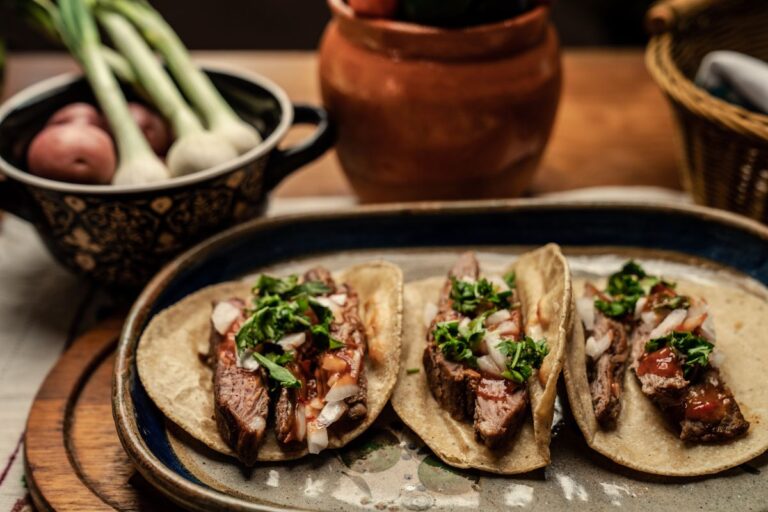
Outside the West Coast, many packers grind tri tip or cut it into sirloin steaks. Ranchers who sell by the quarter or half usually have it. Search our directory of local beef farmers and ask for whole, untrimmed tri tip. If you like this cut, try our carne asada recipe, which works with sliced tri tip, or a slower beef dinner like our porcini red wine pot roast.