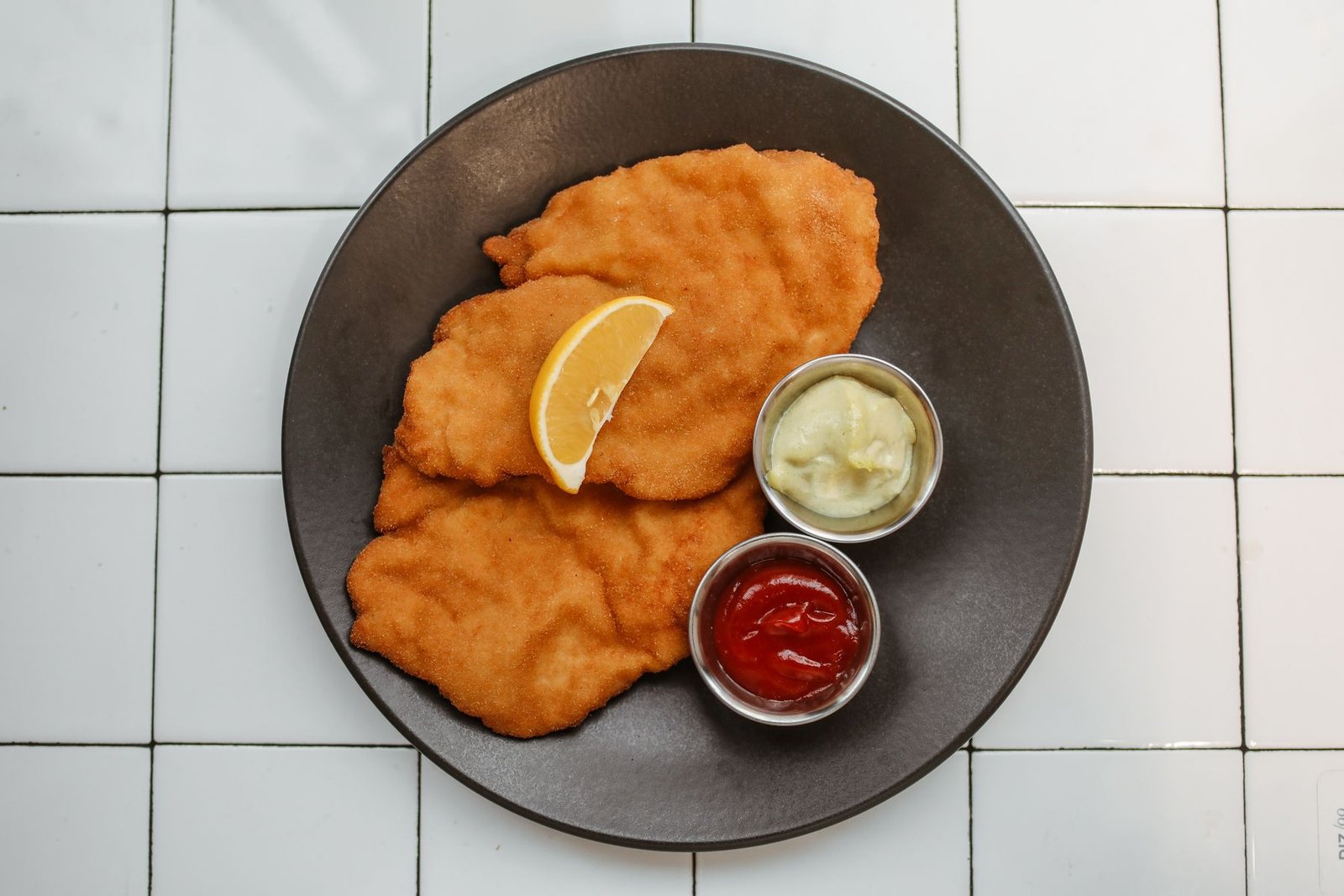
Wiener Schnitzel with Warm Viennese Potato and Cucumber Salad
Most Wiener Schnitzel recipes online pound the veal to 1/4 inch, press the crumbs on with their palms, and fry in a skim of oil. The result is a breaded cutlet, and a fine one, but not the dish Vienna is known for. A proper schnitzel is thinner, around 4 mm, and the crumb coat sits on it loosely, so when it hits deep enough fat the egg layer steams and lifts the crust into golden waves that pull away from the meat.
Our tip up front: buy more fat than you think you need. The cutlet has to float, and swirling the pan to wash hot lard over the top is the whole technique.
We serve it the way Viennese inns do, with a warm potato and cucumber salad dressed in hot stock and vinegar while the potatoes are still steaming. That salad is the hero here. Its sharpness cuts the fried crust better than any sauce, and it is the side most American recipes skip or replace with mayonnaise potato salad.
Why this recipe works
- The right muscle. Top round, the Austrian Schale, pounds evenly instead of splitting along seams.
- Thin enough to puff. At 4 mm the meat cooks through in the time the crust takes to brown.
- Fat as a cooking medium. Lard or clarified butter at 320 to 340F, deep enough to float the cutlet, lifts the crust.
- A dressed warm salad. Hot stock and vinegar soak into the potatoes and cut the fried crust.
- An honest word on doneness. The thermometer belongs in the fat, not the meat.
Which cut to buy for Wiener Schnitzel
Ask for veal top round, also sold as inside round. In Austria the classic schnitzel comes from the Schale (topside) or the Kaiserteil, a tender piece from the top of the hind leg near the hip. Both are single muscles with fine grain, so they flatten into an even sheet. Our veal leg guide shows where these muscles sit. Have it sliced across the grain 1/4 inch (6 mm) thick, 5 to 6 oz (140 to 170 g) each.
Acceptable alternatives: the knuckle (sirloin tip) or eye of round, trimmed well. Boneless cutlets from the veal loin pound well but cost about twice as much for no gain once breaded. Avoid shoulder and anything labelled only “veal for scallopini” in a mixed pack. Those slices cross several muscles, and the seams pull apart under the mallet. See our veal cuts chart if your butcher uses different names.
Ingredients
For the schnitzel (4 servings)
- 4 veal top round cutlets, 5 to 6 oz (140 to 170 g) each, sliced 1/4 inch (6 mm) thick
- 1 teaspoon (6 g) fine sea salt, plus black pepper
- 3/4 cup (100 g) all purpose flour
- 2 large eggs beaten with 1 tablespoon (15 ml) milk
- 2 cups (100 g) fine dry white breadcrumbs, made from crustless day old white bread or rolls
- 3 to 4 cups (700 ml to 1 liter) melted lard or clarified butter, enough for 3/4 inch (2 cm) in the pan
- 1 lemon, cut into wedges
For the warm potato and cucumber salad
- 1.5 lb (680 g) small waxy potatoes, such as Yukon Gold or fingerlings
- 1/2 cup (120 ml) hot chicken or beef stock
- 3 tablespoons (45 ml) white wine vinegar
- 1 teaspoon (4 g) sugar
- 1 teaspoon (5 g) Dijon mustard
- 1 small onion (70 g), finely diced
- 3 tablespoons (45 ml) sunflower oil, or half sunflower and half Styrian pumpkin seed oil
- 1 English cucumber (300 g), sliced paper thin
- 1/2 teaspoon (3 g) salt for the cucumber
- 2 tablespoons (6 g) chopped chives
Substitutions: neutral oil with 2 tablespoons (30 ml) butter works without lard, though the crust tastes flatter. Avoid panko; its flakes will not soufflé. Beat the eggs with water for a dairy free version.
Method
1. Boil the potatoes
Put 1.5 lb (680 g) waxy potatoes, whole and unpeeled, in cold salted water and simmer 20 to 25 minutes until a skewer slides in. Skins on keeps the flesh from getting waterlogged.
2. Dress the salad warm
Peel the potatoes hot and slice them 1/4 inch (6 mm) thick into a wide bowl. Bring the stock, vinegar, sugar, mustard and onion to a simmer and pour it over. Toss with a wooden spoon and leave 30 minutes; warm starch absorbs liquid, cold starch only gets coated. Salt the cucumber in a separate bowl.
3. Pound the veal
Lay each cutlet between two sheets of parchment on a wooden board. With the flat face of a wooden or metal mallet, work from the center outward with glancing blows until the meat is an even 4 mm (a little over 1/8 inch). Parchment does not shed; plastic wrap tears and leaves fragments in the meat. Snip the edges so they do not curl.
4. Set up the breading station
Spread the flour on one plate, beat the eggs with the milk on a second, and loosely pile the crumbs on a third. Season the cutlets only now, so salt has no time to pull moisture to the surface.
5. Heat the fat
Melt the lard or clarified butter in a 12 inch (30 cm) cast iron skillet to a depth of about 3/4 inch (2 cm) and bring it to 320 to 340F. Below 320F the crumbs soak up fat; above 350F the crust darkens before the egg layer can steam and lift.
6. Bread at the last moment
Dredge one cutlet in flour and shake off the excess, drag it through the egg so no dry spot remains, then lay it in the crumbs and scatter more on top. Turn it once and lift it out. Do not press. A loose crumb layer is what puffs.
7. Fry and swirl
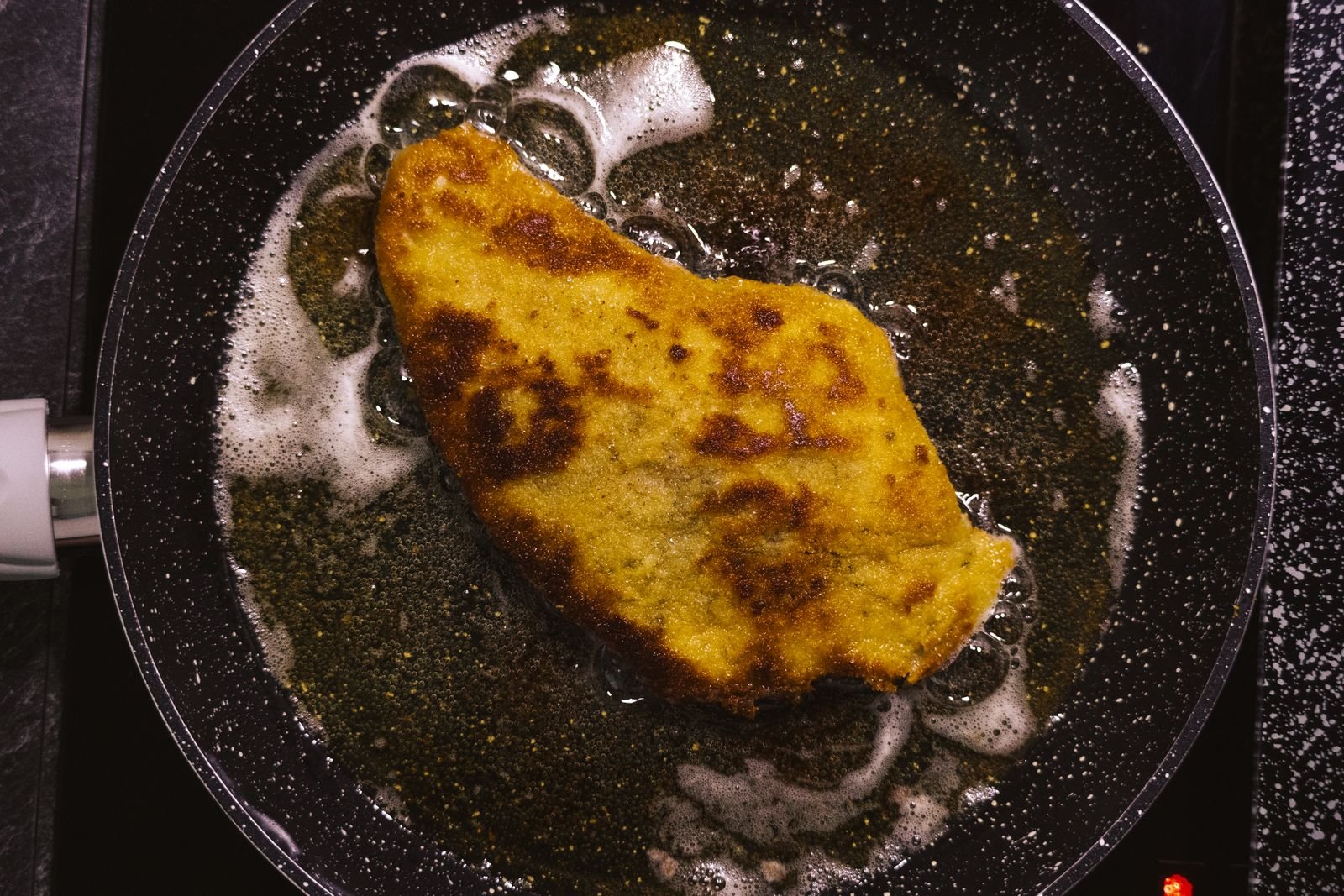
Lay the cutlet away from you into the fat; it should float. Swirl the pan in small circles, or spoon fat over the top, for 1.5 to 2 minutes until the underside is deep gold and the crust has risen in waves. Turn with a metal fish spatula and fry 1 to 1.5 minutes more.
8. Drain and serve
Drain the schnitzel on a rack and plate it within minutes. Squeeze the cucumber, fold it through the potatoes with the oil and chives, and serve alongside with a lemon wedge.
Wiener Schnitzel or veal Milanese: the real differences
People treat these as the same dish with two names. They are cousins. Our veal Milanese with marinated mushroom and arugula salad follows the Lombard tradition: a bone in rib chop, pounded only lightly so it stays thicker, often dipped in egg and crumbs without flour, and fried in a generous amount of butter. It eats like a chop with a crust.
Wiener Schnitzel goes the other way. It is boneless, cut from the leg, pounded to roughly the thickness of two stacked coins, and floured before the egg. The flour gives the egg a dry layer to grip, part of why the crust can lift. It also uses far more fat: a schnitzel needs to float so swirling fat reaches the top surface.
If you want a thicker veal chop without breading, our veal chop with chanterelles and sage butter is a better fit, and our pan searing guide covers that technique.
Why internal temperature does not matter at 4 mm
We usually give a target internal temperature. Here we do not, for a physical reason. Heat travels into meat from both faces. At 4 mm, the center is only 2 mm from fat at 330F. In the first 90 seconds the core passes 160F, well beyond the USDA 145F guidance for whole veal cuts.
There is also a practical problem. An instant read probe like our Thermapen needs about 1/4 inch of meat to seat the tip, and poking it through the crust tears the soufflé you just built. So put the thermometer in the fat instead. Our meat thermometer reviews cover models that read hot oil quickly.
Judge by color instead: deep gold with darker ridges. Pale means cool fat.
Rose veal, bob veal and pasture raised veal
The veal on a grocery tray can come from three different animals. Bob veal comes from calves only a few weeks old. It is pale and so soft that it often tears under the mallet, with little flavor. Formula fed veal, raised to around five months, is the classic pale restaurant veal.
Rose veal, a term common in the UK, and pasture raised veal in the US come from calves raised longer, often six to eight months, with room to move and access to grass or hay. The meat is a deeper pink, the grain slightly firmer, and the flavor closer to young beef. It makes an excellent schnitzel. Pound it more patiently, since the fibers resist, and expect the meat to brown a shade darker. Its fat can look faintly yellow from carotene in grass. Our veal hub explains how these systems differ on welfare as well as flavor.
Pro tips and common mistakes
- Use the flat face of the mallet. The toothed side shreds thin veal into holes that leak fat under the crust.
- Make your own crumbs. Dry crustless white bread in a low oven, then blitz until fine as sand.
- Use a wide pan. A 12 inch cast iron skillet leaves room to swirl and holds heat. See our cast iron skillet picks.
- Turn with metal, not tongs. A metal fish spatula slides under the crust without piercing it. Wooden tools are fine for the salad; our non plastic utensils guide covers both.
Troubleshooting
Symptom: The crust is greasy and limp. Cause: Fat below 320F, or the pan was crowded and the temperature crashed. Fix: Fry one cutlet at a time and wait for the thermometer to climb back before adding the next.
Symptom: The crust is flat and glued to the meat. Cause: Crumbs were pressed in, or the cutlet sat breaded before frying. Fix: Lay crumbs on loosely and go straight from the crumb plate to the fat.
Symptom: The crust burned before the second side colored. Cause: Fat above 350F, or butter that was not clarified, so milk solids scorched. Fix: Lower the heat a notch and use lard or properly clarified butter.
Symptom: The meat curled into a bowl shape. Cause: Silverskin or a seam tightened as it cooked. Fix: Trim visible sinew and snip the edges before breading.
Storage and leftovers
Schnitzel is best within ten minutes of frying. Leftovers keep, covered, in the refrigerator for up to 3 days. Reheat on a rack in a 400F oven for 6 to 8 minutes; the microwave turns the crust to sponge. The potato salad keeps 2 days, but add the cucumber fresh, since it weeps once dressed. Strain the lard and chill it for one more round.
What to serve with Wiener Schnitzel
- Lingonberry jam. A spoonful adds tart sweetness.
- Parsley potatoes. Boiled and tossed in butter and parsley.
- Green salad with pumpkin seed oil. Butter lettuce in a Styrian vinaigrette.
- A dry Grüner Veltliner or a Märzen lager. Both cut the fat.
Nutrition (estimate per serving, 4 servings): 690 calories, 39 g protein, 33 g fat, 58 g carbohydrate. Estimated from the ingredient list and yield, not a lab value.
Frequently asked questions
Can Wiener Schnitzel be made with pork or chicken?
Yes, but it is no longer Wiener Schnitzel. In Austria a pork version is sold as Schnitzel Wiener Art, meaning Viennese style. Pork leg and chicken breast work with the same method and thickness.
Why did my breading stick flat to the meat instead of puffing?
Usually the crumbs were pressed on, the fat was too shallow, or the cutlet sat breaded for too long before frying. Lay crumbs on loosely and fry within a minute.
Do I need to check the internal temperature of the veal?
No. At 4 mm the cutlet passes 160F at the center in about a minute per side, well past the USDA 145F guidance for veal. A probe cannot seat in meat that thin, so judge by crust color and fat temperature instead.
What is the difference between Wiener Schnitzel and veal Milanese?
Wiener Schnitzel is a boneless leg cutlet pounded to about 4 mm and fried swimming in lard or clarified butter until the crust puffs. Classic cotoletta alla milanese is a bone in rib chop, left thicker and fried in butter, so it eats more like a chop.
Can I bread the schnitzel ahead and chill it?
We advise against it. Chilled breading absorbs egg moisture and glues itself to the meat, which is the opposite of the loose wavy crust you want. Pound ahead if you like, but bread just before frying.
Where to buy the meat
Good veal top round is easiest to find from a farm that raises its own calves, where you can ask how old the animals were. Use our Find a Farmer directory to locate rose or pasture raised veal near you, and ask for the leg cut into single muscle cutlets.