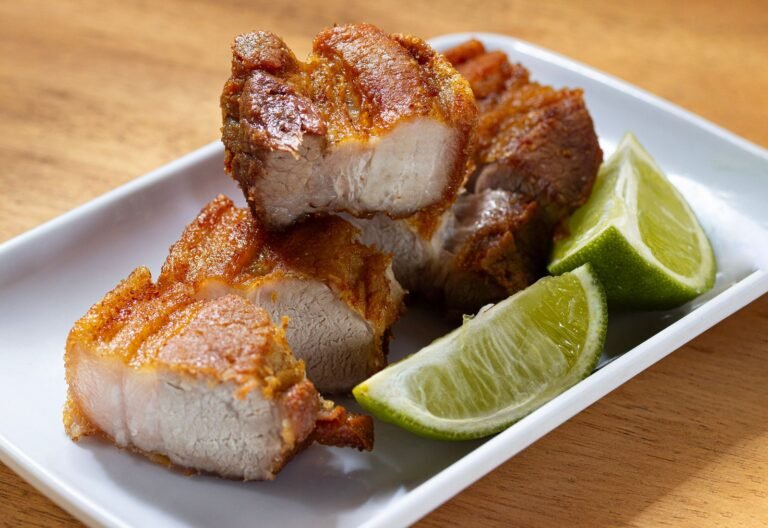
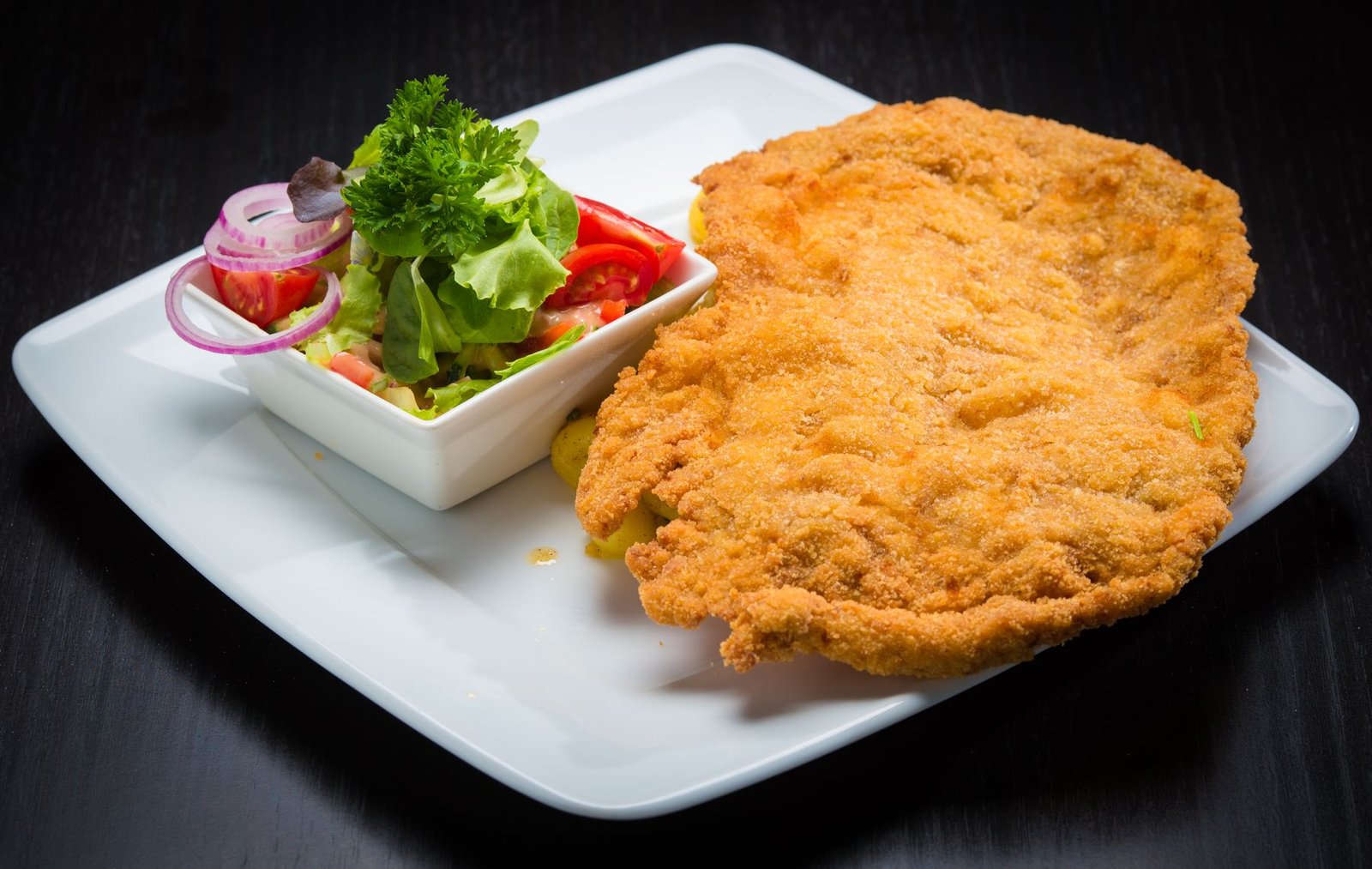
Pork Schnitzel with Warm Apple Sauerkraut
Most pork schnitzel recipes tell you to buy boneless chops, wrap them in plastic, pound and fry to 145F. None mention why the cutlets came out pale, spat oil and tasted like ham. That is enhanced pork, injected with salt water at the plant.
Our tip up front: buy chops with no added solution on the label, ideally heritage or pasture raised, and pound them between parchment. The rest is fat at 330 to 350F, two minutes a side, and a light hand with the crumbs so the crust puffs away from the meat.
This is Schnitzel Wiener Art, the pork cousin of our veal Wiener Schnitzel. Instead of Jägerschnitzel mushroom gravy, which softens the crust, we serve warm apple sauerkraut sharpened with grainy mustard.
Why this recipe works
- Untreated pork browns. Chops without injected brine dry fast on the surface and fry gold instead of steaming.
- Parchment, not plastic. A wooden or metal mallet and parchment give an even 1/4 inch cutlet without hammering film into the meat.
- Warm apple sauerkraut on the side. Sour and caraway scented with a little apple sweetness, it does the job of gravy while the crust stays crisp.
- A real temperature window. Fat at 330 to 350F, checked with a thermometer, separates a puffed crust from a greasy one.
Which cut to buy for pork schnitzel
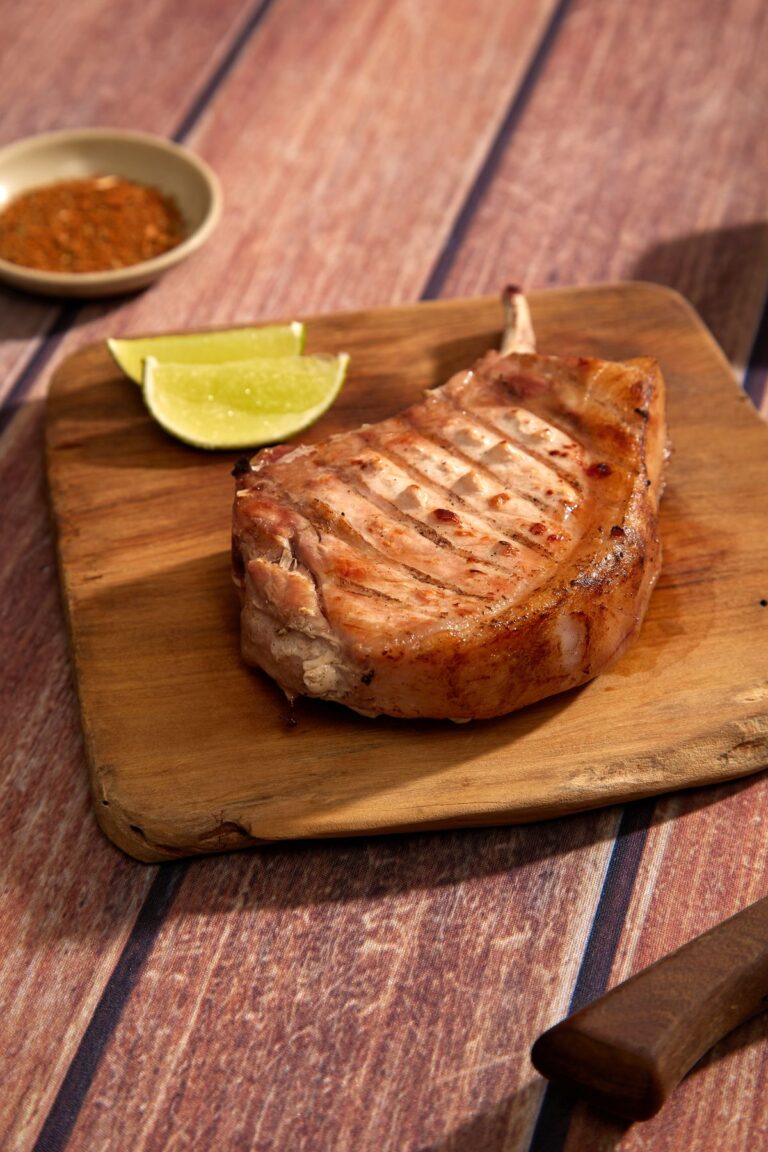
Our first choice is boneless center cut loin chops, the same muscle as pork chops and a whole pork loin roast. The grain is even and a 1/2 inch chop pounds out to the size of your hand.
Two good alternatives. Pork tenderloin medallions give smaller, softer cutlets. Leg cutlets from a fresh ham are the German butcher’s choice: lean, broad and cheap.
Avoid anything labeled enhanced or containing a percentage of solution, and skip blade chops, which tear when pounded. Our pork guide shows where each cut sits.
Ingredients
For the schnitzel
- 1 1/2 lb (680 g) boneless center cut pork loin chops, untreated
- 1 1/2 teaspoons (9 g) fine sea salt, plus more for finishing
- 1/2 teaspoon (1 g) freshly ground black pepper
- 1/2 cup (65 g) all purpose flour
- 2 large eggs (100 g)
- 2 tablespoons (30 ml) heavy cream or whole milk
- 1 1/2 cups (150 g) fine dry breadcrumbs, plain
- 1 cup (200 g) lard
- 1 cup (240 ml) neutral oil such as sunflower
- 1 tablespoon (14 g) butter, optional
- 1 lemon, cut into wedges
For the warm apple sauerkraut
- 2 tablespoons (25 g) lard or butter
- 1 medium onion (150 g), thinly sliced
- 1 tart apple such as Granny Smith (180 g), coarsely grated
- 1 lb (450 g) raw sauerkraut, drained and lightly squeezed
- 1/2 cup (120 ml) dry hard cider or apple juice
- 1/2 teaspoon (1 g) caraway seeds
- 1 bay leaf
- 1 tablespoon (15 g) grainy German mustard
Substitutions: All oil works in place of lard, with a less savory crust. Panko stays flat rather than puffing. Dry white wine can replace the cider. Rinse canned sauerkraut once.
Method
1. Make the apple sauerkraut
Soften the onion in the lard over medium heat for 6 to 8 minutes. Add the apple, caraway, bay, sauerkraut and cider, cover and simmer 20 minutes until the cider is mostly gone. Stir in the mustard and hold on low heat.
2. Trim and slice the pork
Trim the fat and silverskin. Butterfly any chop thicker than 3/4 inch (2 cm) so each piece starts near 1/2 inch (12 mm).
3. Pound between parchment
Pound each piece between two sheets of parchment with a wooden or metal mallet to an even 1/4 inch (6 mm). Use glancing strokes that push outward from the center. Straight blows punch holes.
4. Season and set up the breading
Salt and pepper both sides. Set out flour, then eggs beaten with the cream, then breadcrumbs kept loose in their dish.
5. Bread at the last minute
Flour and shake off the excess, dip in egg and let it drip, then lay the cutlet in the crumbs and press lightly. A loose coat is what puffs. Bread right before frying; a damp coat fuses flat.
6. Heat the fat
Heat about 1/2 inch (12 mm) of lard and oil in a wide heavy skillet to 330 to 350F. Below 330F the crumbs drink fat. Above 350F they scorch before the meat sets.
7. Fry and swirl
Lay in one or two cutlets away from you. Shake the pan and spoon fat over the top so the crust lifts from the meat. Fry about 2 minutes, flip with a metal fish spatula, add the butter if using, and fry about 2 minutes more until deep gold. Let the fat recover to 330F between batches.
8. Drain and serve
Drain on a wire rack and salt at once. Hold batches in a 200F (95C) oven. Serve with the sauerkraut beside the schnitzel, not under it, and lemon.
Why 145F takes two minutes at this thickness
The USDA safe temperature for whole cuts of pork is 145F with a three minute rest. You cannot probe a 1/4 inch cutlet, and you do not need to. The time heat takes to reach the center scales with the square of the thickness. Quarter the thickness and the time drops to about a sixteenth.
A 6 mm cutlet in 330F fat sets through in about 90 seconds. By the time both sides are gold, the center is well past 145F. Fold a finished cutlet and slide a Thermapen into the fold if you want proof. The real risk is overcooking. Trust the crust color and the clock, and keep the thermometer for the fat.
Enhanced pork, heritage pork and hot fat
Much supermarket pork is injected with water, salt and sodium phosphate, often 8 to 12 percent by weight. In a schnitzel that water boils out under the crumb. The coating steams, the oil spits, and the meat turns springy and hammy.
Heritage and pasture raised pork goes the other way. Berkshire, Red Wattle and similar breeds carry darker meat with more intramuscular fat and a higher pH, so it stays juicy at 1/4 inch. It can stay faintly pink when fully cooked. It also browns faster. Start at 330F and give it the full two minutes. Nick any fat edge so the cutlet lies flat.
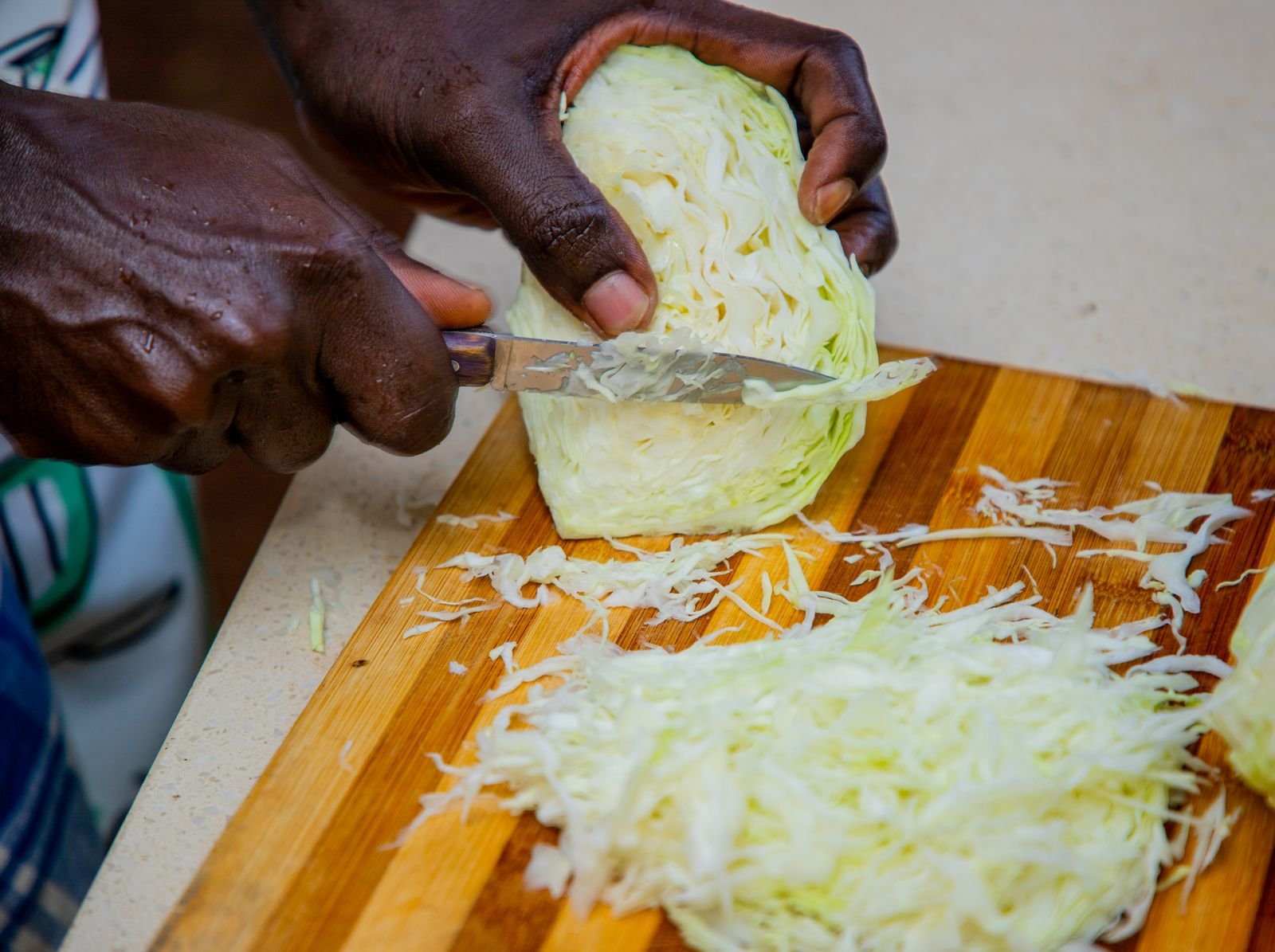
The warm apple sauerkraut
German menus offer schnitzel plain with lemon, as Jägerschnitzel under mushroom gravy, or with a paprika pepper sauce. Gravy drowns the crust. We prefer Apfelsauerkraut, sauerkraut braised briefly with apple, onion and caraway, a common home pairing in southern Germany.
Raw refrigerated sauerkraut is a live ferment with clean lactic sourness. A short braise in lard and cider softens its edge without losing the snap. The grated apple melts in and sweetens it, caraway pulls it toward the pork, and the spoon of grainy mustard does the work of a sauce. Keep it beside the schnitzel so the crust stays dry.
Pro tips and common mistakes
- Pound outward, not down. Holes let fat under the crust.
- Use a wide, heavy pan. A 12 inch cast iron skillet like our Lodge holds heat when cold meat goes in.
- Fry one or two at a time. Crowding drops the fat below 330F in seconds.
- Turn with a metal fish spatula. It slides under the crust without tearing it.
Troubleshooting
Symptom: Pale, soft crust and spitting oil. Cause: Enhanced pork, or fat below 330F. Fix: Buy untreated pork and check the fat before each batch.
Symptom: Crust slides off in one sheet. Cause: Wet meat or too much flour. Fix: Pat dry and shake off the flour.
Symptom: Dark crust, chewy meat. Cause: Fat above 350F or too long in the pan. Fix: Lower the heat and pull at 2 minutes a side.
Storage and leftovers
Refrigerate cooled cutlets for up to 3 days and reheat on a rack at 400F (200C) for 8 to 10 minutes; the microwave turns the crust to sponge. The sauerkraut keeps 5 days and improves by day two.
What to serve with pork schnitzel
- Warm German potato salad dressed with vinegar and broth
- Buttered spaetzle or parsley potatoes
- Cucumber salad with dill
- Lingonberry jam, the Austrian habit
On a night without frying, our pan seared pork chops suit the same sauerkraut, and the pan searing guide covers heat control.
Nutrition (estimate per serving, 4 servings): 640 calories, 43 g protein, 36 g fat, 36 g carbohydrate. Estimated from the ingredient list and yield, not a lab value.
Frequently asked questions
Is pork schnitzel safe if it is still slightly pink?
Yes, once it reaches 145F, the USDA safe temperature for whole cuts of pork. A 1/4 inch cutlet fried two minutes a side is far past that, so a faint blush in heritage pork is color, not risk.
What is the difference between pork schnitzel and Wiener Schnitzel?
In Austria Wiener Schnitzel must be veal. Made with pork it is Schnitzel Wiener Art, Viennese style, with the same method.
Can I use pork tenderloin for schnitzel?
Yes. Cut 1 1/2 inch (4 cm) medallions, stand them on end and pound to 1/4 inch. They are smaller and milder and cook about 30 seconds faster per side.
Why did my schnitzel crust come out flat and greasy?
Cool fat, crumbs pressed in hard, or a cutlet that sat breaded too long. Fry at 330 to 350F, press lightly, bread at the last minute and swirl the pan.
Can I bake or air fry pork schnitzel instead?
You can, but the crust stays dry and tight, because the puffed crust needs hot fat under the coating. A shallower 1/4 inch of fat is the better compromise.
Where to buy the meat
Look for untreated pork loin from heritage breeds raised on pasture. Many farms will cut loin chops or leg cutlets to order. Our Find a Farmer directory lists pork producers near you.