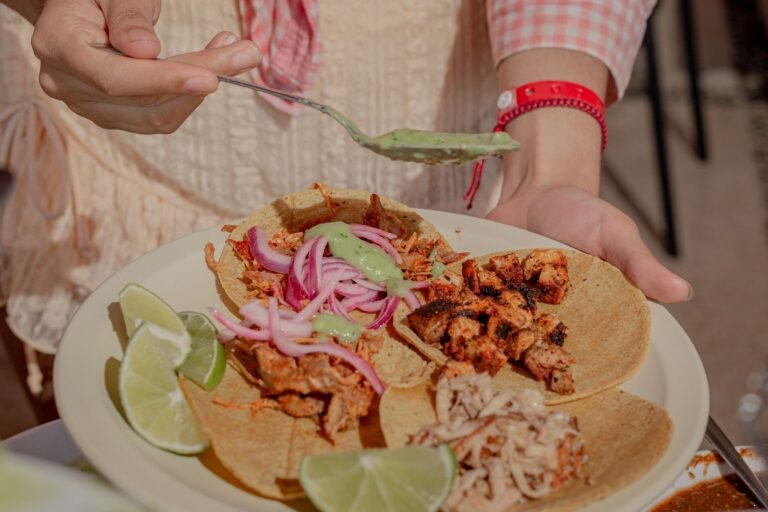
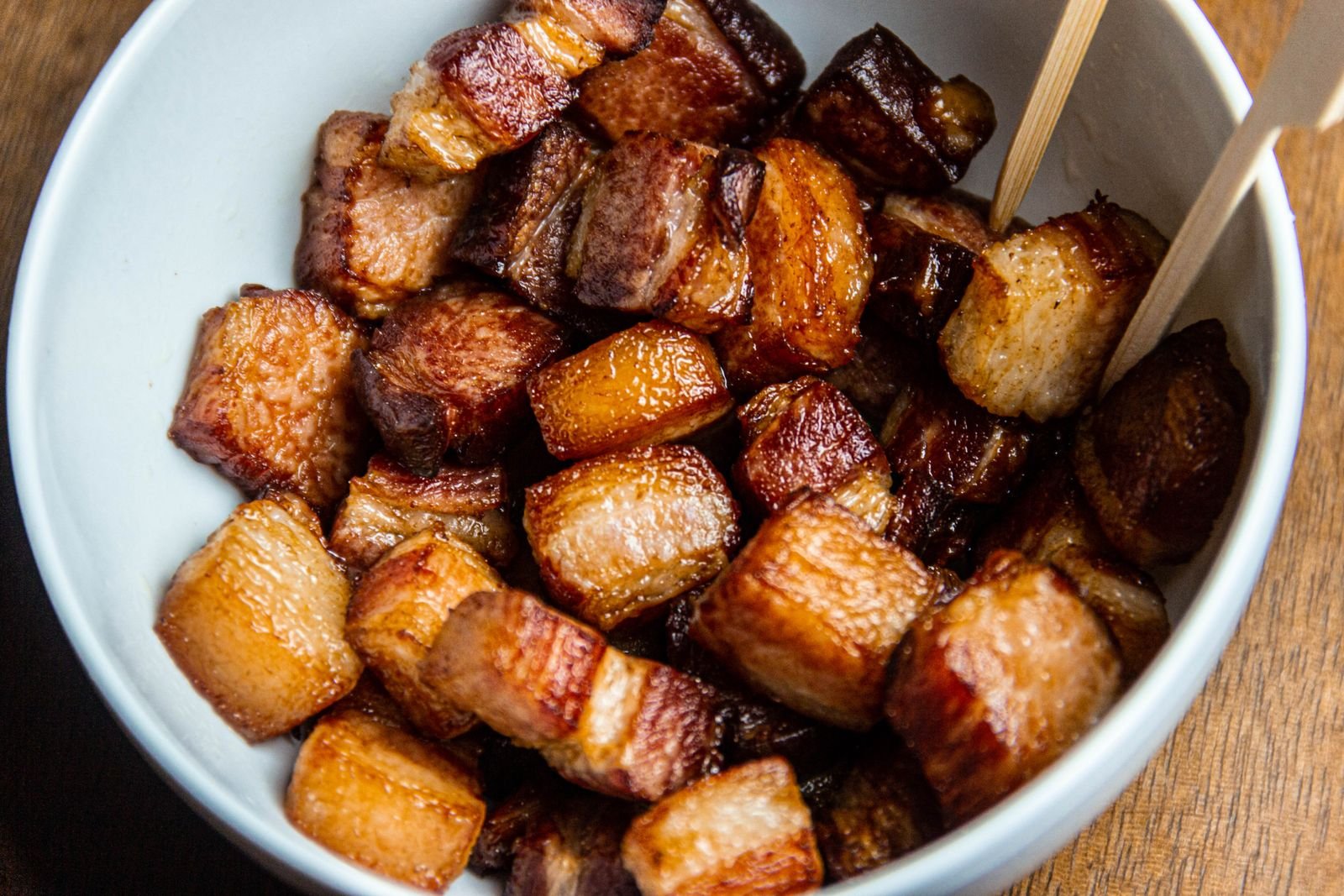
Pork Belly Burnt Ends with Gochujang Honey Glaze
The two recipes ranking top here both cook by the clock. One admits it never checked an internal temperature and guesses around 205F. The other says 145F is done, which is right for a pork chop and wrong for a cube of belly. That gap is why home batches land chewy or greasy.
Our first tip: burnt ends finish on collagen, not time. Pull them when a cube reads 198 to 203F in the center and a thin probe slides in with no push back. At 250F that takes about 4 hours.
The hero addition is a gochujang and honey glaze instead of bottled barbecue sauce. By the time the cubes are tender they have sat 90 minutes in brown sugar and butter. Tomato and corn syrup on top of that is sugar on sugar. Gochujang brings fermented salt, slow chili heat, and enough body to cling to a hot cube.
Why this recipe works
- A real doneness window. 198 to 203F in the center, confirmed by probe feel.
- It names which end of the belly to buy. Shoulder end and flank end cook at different speeds.
- The covered pan is a braise, not a shortcut. You are steaming connective tissue apart, so the timing has a reason behind it.
- Pasture raised belly gets its own timing. Firmer fat renders slower.
- The glaze balances the cook instead of repeating it. Salt and acid against rendered fat and sugar.
Which pork belly to buy, and which end
Start with a flat slab of pork belly between 1.25 and 1.75 inches thick. Thinner and the cubes dry out before the fat renders. Thicker and the center lags the bark by close to an hour.
Ask for it skinless. Skin on belly is right for crispy roast pork belly, where one sheet of rind blisters under high heat. At 250F skin never gets dry enough to crisp. It sits there as a rubbery lid, blocking smoke and rub from the fat underneath. Peel it with a boning knife and save it for crackling.
The pork belly primal runs from the shoulder end to the flank end. The shoulder end is meatier and holds its shape in the pan. The flank end is fattier and can collapse. We buy the shoulder end. If your slab covers both, cut the fattier half slightly larger so everything finishes together.
Cube size matters more than most recipes admit. Use 1.5 inches. At 1 inch you get bark on all six faces and no soft interior. At 2 inches the outside overcooks waiting on the middle. Use a wood board and steel tongs rather than plastic, since hot fat and cutting pressure shed microplastics into food.
Ingredients
Pork
- 3 lb (1.4 kg) skinless pork belly, cut into 1.5 inch (4 cm) cubes
Rub
- 1 tablespoon plus 1 teaspoon (16 g) fine sea salt
- 2 tablespoons (26 g) dark brown sugar
- 1 tablespoon (7 g) coarse black pepper
- 2 teaspoons (5 g) smoked paprika
- 2 teaspoons (6 g) garlic powder
- 1 teaspoon (3 g) onion powder
For the covered pan
- 1/3 cup (73 g) dark brown sugar
- 4 tablespoons (57 g) unsalted butter, sliced
- 2 tablespoons (30 ml) cider vinegar
Gochujang and honey glaze
- 1/3 cup (90 g) gochujang
- 1/4 cup (85 g) honey
- 2 tablespoons (30 ml) soy sauce or tamari
- 2 tablespoons (30 ml) unseasoned rice vinegar
- 1 tablespoon (15 ml) toasted sesame oil
- 3 garlic cloves, grated
- 1 tablespoon (8 g) grated fresh ginger
Substitutions. No gochujang? Use 1/4 cup white miso plus 2 teaspoons gochugaru. The heat shifts, the fermented salt stays, and that is the part doing the work. Maple syrup replaces honey one for one. Tamari keeps it gluten free. For milder, drop to 2 tablespoons gochujang and add 2 tablespoons tomato paste.
How to make pork belly burnt ends
1. Trim and cube the belly
Pull the skin if it is still on. Square the slab so thickness is even, then cut 1.5 inch cubes. Even thickness is what makes a tray finish together instead of in waves. Leave the fat cap on.
2. Rub, then rest 40 minutes
Toss the cubes in the rub until every face is coated. Rest on a wire rack at room temperature for 40 minutes. Salt pulls moisture up, dissolves, then draws back in, leaving a tacky surface that holds smoke.
3. Set the smoker to 250F
Run indirect at 250F (120C) with two chunks of cherry or apple. Above 275F the outside sets before the fat moves. Below 225F the cook stretches past 6 hours for no gain. For fuel and airflow, see our guide to smoking meat.
4. Smoke the cubes bare to 165 to 175F
Cubes on a wire rack, fat side up, half an inch apart. Lid shut for 2 hours. You are building bark, and the fat is only starting to render. You want 165 to 175F and a dry surface that does not smear under your thumb.
5. Pan the cubes and cover them
Move the cubes to a metal half pan. Scatter the brown sugar, butter and cider vinegar over them, then cover tightly with heavy foil. Other recipes call this a shortcut. It is a braise. The sealed pan traps steam near 212F, and moist heat converts collagen to gelatin far faster than dry heat does. Foil is the honest answer here, though a tight metal lid works as well.
6. Braise 90 minutes to 198 to 203F
Back on the smoker, 90 minutes to 2 hours. Start probing at 75 minutes. You want 198 to 203F in a cube from the middle of the pan. Below 195F the collagen has not finished and the bite is rubbery. Above 207F the fibers give up their water and you get a dry cube swimming in fat.
7. Make the glaze and drain the pan
Whisk the glaze ingredients in a small saucepan and warm over medium heat for 3 minutes, until the garlic smells cooked. Pull the pan off the smoker, uncover, and pour off the liquid fat. Do not skip the draining. Anything left behind thins your glaze into a puddle.
8. Glaze, set 10 minutes, rest 10 minutes
Spoon the glaze over the drained cubes and turn until coated. Return the uncovered pan to the smoker for 8 to 10 minutes, until the sugars tighten and go glossy. Rest 10 minutes. The rest is short on purpose. These are small pieces, so you are letting the glaze stop running, not redistributing juices as you would with a roast.
How to tell when burnt ends are actually done
Two things happen inside a belly cube, at different temperatures. Fat starts flowing in earnest around 130 to 140F. Collagen between the lean streaks does not convert to gelatin at any useful speed until roughly 160F, and it needs sustained time above 180F to finish. That is why 145F is the wrong target, even though it is the correct safe temperature for whole muscle pork. At 145F a belly cube is safe and unpleasant.
Test three cubes from different spots with a thin instant read probe. A pan over a hot corner of the firebox can run 10F apart edge to center. Temperature gets you close, probe feel confirms it. No resistance going in, soft squeeze, shape still holding. Stop there.
Why gochujang and honey instead of barbecue sauce
Look at what the cube has absorbed by step 7. Brown sugar from the rub, brown sugar from the pan, butter, and its own rendered fat. Bottled barbecue sauce is mostly tomato, sugar and vinegar, sugar leading. Adding it finishes a sweet dish with more sweet.
Gochujang is fermented chili paste built on glutinous rice, chili powder and soybean. Its salt concentration runs far higher than barbecue sauce, and salt reads directly against fat. The fermented soybean adds glutamates that land as savory depth rather than sweetness, and its starchy body clings to a hot greasy surface instead of running off. Honey is for gloss, not to lead. The same logic drives our char siu pork with quick pickled daikon.
Pasture raised pork belly behaves differently
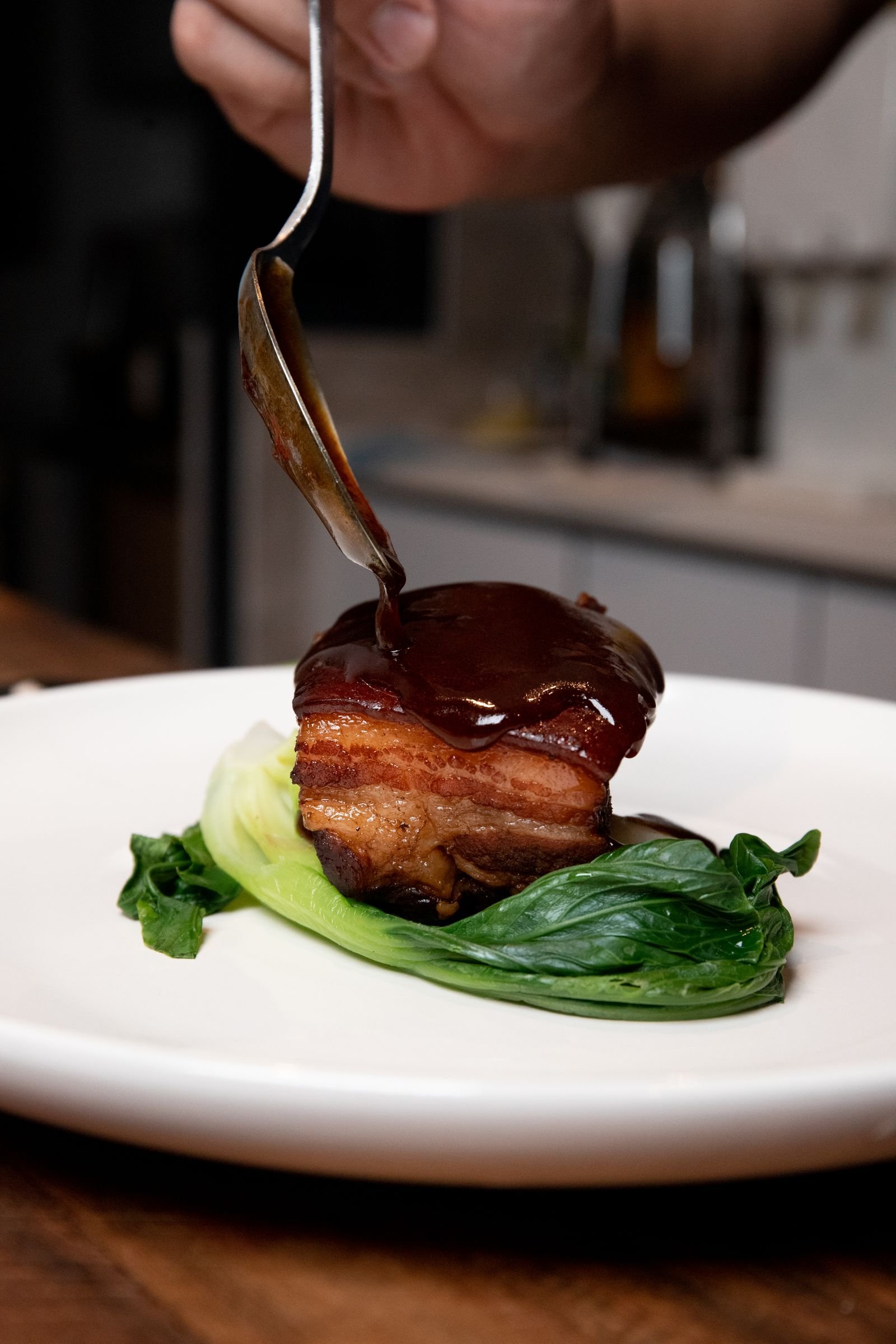
Belly from pigs raised outdoors on pasture and forage changes the cook. Those pigs move, and they take longer to reach finishing weight. The fat is firmer at room temperature, with a higher proportion of saturated and monounsaturated fat and a denser cell structure. It renders slower than fat from a fast finished confinement pig. So add 30 to 45 minutes to the covered braise, and do not panic when the cubes still feel firm at 90 minutes. Probe, do not guess. The target temperature does not change. The time to reach it does.
Pro tips and common mistakes
- Do not crowd the rack. Cubes touching each other steam instead of forming bark.
- Glaze last, never early. Honey and gochujang both scorch above 300F and turn bitter over a long cook.
- Save the drained fat. Strain it into a glass jar and keep it in the fridge. It is seasoned lard, and it makes very good roast potatoes.
- Use metal and wood tools. Steel tongs, a metal pan, a wooden board. Plastic against fat above 200F is a needless source of microplastics in food.
- Cook one extra cube. Make it the test piece so you are never probing what you plan to serve.
Troubleshooting
- Chewy meat, fat rendered fine. Cause: pulled early, around 185 to 190F. Fix: cover the pan again, return it to 250F for 20 to 30 minutes, re probe.
- Dry, stringy meat in a pool of grease. Cause: taken past about 207F, or the cooker spiked over 300F. Fix: no undo. Chop the cubes, toss with extra glaze, serve on rice.
- Glaze runs off into the pan. Cause: fat not drained, or glaze never warmed. Fix: drain fully, simmer the glaze 2 minutes longer until it coats a spoon, reapply.
- Pale cubes with tacky bark. Cause: smoker humidity too high, or the bare smoke phase cut short. Fix: run the bare phase a full 2 hours and open the vent wider for its last 20 minutes.
- Bitter, acrid edges. Cause: glaze applied before the braise, or dirty smoke from a choked fire. Fix: trim the worst edges, and build a clean fire next time.
Storage and leftovers
Cool the cubes to room temperature within 2 hours, then refrigerate in a sealed glass container for up to 4 days. The glaze firms and the fat sets white. That is normal. Reheat in one layer in a covered metal pan with a tablespoon of water at 300F for 12 to 15 minutes, then uncover 3 minutes to tighten the glaze. They freeze for 3 months.
What to serve with it
- Quick cucumber pickles. Thin slices in rice vinegar, salt and a pinch of sugar for 20 minutes. Acid is what lets you eat a second helping.
- Steamed short grain rice. It catches the glaze and keeps the plate from reading as pure richness.
- Charred cabbage with sesame. Wedges seared hard in a dry pan, finished with sesame oil and salt.
- Cold lager or a dry riesling. Carbonation or acidity to clear fat between bites.
Nutrition
About 640 calories, 22g protein, 51g fat, and 21g carbs per serving, based on 8 servings. These are estimates and vary with the fat to lean ratio of your belly, how much rendered fat you drain off, and how heavily you glaze.
Frequently asked questions
What internal temperature should pork belly burnt ends reach?
198 to 203F in the center of a cube. 145F is the safe temperature for whole muscle pork, but at 145F the collagen in belly has not converted and the texture is springy. This number is about texture, not safety.
Should I buy pork belly with the skin on or off?
Off. At 250F the skin never dries or crisps, and it blocks smoke and rub from the fat beneath. If you can only find it skin on, peel the rind with a boning knife and roast it separately for crackling.
Can I make these without a smoker?
Yes. Run the oven at 250F and toss the cubes with 2 teaspoons of liquid smoke before the rub. Wire rack over a sheet pan for the first 2 hours, then the covered pan as written. You lose bark depth, but the texture holds.
Why did my burnt ends turn out tough?
Almost always because they came off early. Belly passes through a stage around 180 to 190F where it feels cooked and probes firm. That is collagen mid conversion. Give it 20 to 30 minutes more, covered, at 250F.
How spicy is the gochujang glaze?
Moderate, and it builds slowly rather than hitting up front. Gochujang is sold in heat grades, usually marked on the tub. Honey and rendered fat both soften it. For milder, use 2 tablespoons gochujang plus 2 tablespoons tomato paste.
Where to buy pork belly worth cooking
Supermarket belly is usually frozen, skin on and cut thin. A butcher can give you a thick, even slab and pull the skin for you. Better still, buy direct. Our Find a Farmer directory lists producers selling pork by the cut and by the half or whole hog. Ask for belly 1.5 inches thick, skinless, shoulder end. Add a rack of spare ribs while you are ordering. For everything else on the pig, start at our pork cuts guide.