Smoked Brisket with Coffee and Black Pepper Bark Rub
Most brisket recipes hand you one finish temperature and leave it there. 202F. 204F. 205F. The brisket has not read any of them. Two packers of the same weight and the same grade can finish seven degrees apart, because connective tissue and fat load vary from animal to animal, and that gap is why people hit the number, slice, and find a flat that chews like a belt.
We cook to a window and to a feel instead. Here is the honest tip before you buy anything: get the whole packer even if you only plan to eat the flat. A flat sold on its own has no fatty point beside it to buffer the heat, and it dries at the edges hours before the center gives up.
Our one deliberate addition is a coffee and coarse black pepper bark rub. Finely ground dark roast coffee carries roasted bitterness and dark pigment that push the bark deeper and faster than paprika manages, and it sits under beef fat without tasting like a drink. Pepper ground to 16 mesh gives the crust something to hold onto through the wrap.
Why this recipe works
- Doneness is a window plus a feel, not a number. We give you 200 to 207F and the probe test that decides between them, because the number alone has failed more briskets than any other instruction in barbecue.
- The coffee and pepper rub does structural work. Ground coffee is mostly insoluble plant fiber that behaves like a dark spice, darkening the bark and adding roasted bitterness that balances beef fat.
- The cut decision gets explained. Point and flat cook differently, slice differently, and dry out differently, so we tell you which to buy and what a trimmed flat will cost you.
- The cooler hold is a cooking step. It is carryover conversion and juice reabsorption, not a way of keeping dinner warm, and treating it as the latter is why people cut the rest short.
- There is a troubleshooting section. Tough at temperature, dry flat, soft bark, and a cook that will not finish all have causes you can act on.
Which brisket to buy, and which to walk past
Buy a whole untrimmed packer, 12 to 14 pounds, USDA Choice or better. A packer is both muscles still joined by a fat seam, and you can read more about the anatomy on our beef brisket cut page. The lean half is the brisket flat, a long rectangular muscle with tight parallel grain and almost no internal marbling. The fatty half is the brisket point, thicker, marbled through, and the piece that becomes burnt ends.
Pick one up by the middle. It should drape over your hands. A stiff brisket has hard surface fat that will not render in time. Check the thin end of the flat: anything under 1 inch thick there will overcook before the point is ready. More on grades and how the primals relate sits on our beef cuts pillar page.
Walk past three things. Ungraded or Select packers, which have so little intramuscular fat that the flat turns to sawdust. Pre trimmed flats under 5 pounds, which lose too much of their weight to shrinkage. And corned beef, which is brisket already cured in salt and pickling spice and belongs in a different recipe entirely.
Ingredients
Brisket and dry brine
- 1 whole packer brisket, 12 to 14 lb (5.4 to 6.4 kg), untrimmed
- 2 tablespoons (36 g) coarse kosher salt, about 1/2 teaspoon per pound of trimmed meat
Coffee and black pepper rub
- 1/4 cup (30 g) coarse ground black pepper, 16 mesh
- 2 tablespoons (12 g) finely ground dark roast coffee
- 1 tablespoon (12 g) dark brown sugar
- 2 teaspoons (6 g) garlic powder
- 2 teaspoons (6 g) onion powder
- 1 teaspoon (3 g) ground ancho chile
Spritz and wrap
- 1 cup (240 ml) water or unsalted beef stock
- 2 tablespoons (30 ml) cider vinegar
- 2 tablespoons (28 g) rendered beef tallow, from your own trim
- Unwaxed pink butcher paper
Substitutions. Instant espresso powder works in place of ground coffee at half the quantity, since it dissolves and tastes stronger. Skip the brown sugar if you run your pit above 275F, where it scorches. Ancho can become sweet paprika for color without heat, or chipotle if you want smoke on smoke. Any unsalted stock will do for the spritz, and plain water is genuinely fine, since the liquid is there to keep the surface tacky rather than to add flavor. Unsalted butter can replace tallow in the wrap, though it browns differently and tastes of dairy. If you cannot get butcher paper, heavy duty foil works, but say goodbye to a crisp bark.
How we smoke a whole packer brisket
1. Trim the packer
Keep the brisket cold, straight from the refrigerator, because cold fat cuts clean and warm fat smears. Lay it fat side down on a wood board and take off the hard silverskin and the grey surface fat from the meat side. Flip it and pare the fat cap back to 1/4 inch, measured against your thumbnail rather than guessed. Round off the thin corners of the flat so nothing hangs out thinner than about 1 inch, since those edges turn to jerky while the center is still cooking. Save every scrap of trim. Render it slowly in a Lodge cast iron skillet and you have the tallow for step 6.
2. Dry brine overnight
Salt the brisket at a rate of about 1/2 teaspoon of coarse kosher salt per pound of trimmed meat, spread evenly over every surface. Put it uncovered on a rack over a metal tray in the refrigerator for 12 to 24 hours. Salt needs that long to move past the surface, and the open air dries the exterior just enough that the rub grips in the morning. No other spice penetrates, so this is the only step that seasons the inside of the meat.
3. Mix and apply the coffee pepper rub
Grind the peppercorns coarse, roughly the size of cracked wheat, and grind the coffee fine. Stir the rub together in a metal or wood bowl and press it onto all sides with your hands rather than shaking it from a height, which wastes half of it. Go heavy on the flat, which has the least fat to carry flavor. Let it sit 30 to 45 minutes until the rub looks wet and dark, then return the brisket to the refrigerator while the smoker comes up. Cold meat collects more smoke on the way to temperature.
4. Fire the smoker to 250F
Bring the cooker to a steady 250F with a clean fire burning thin blue smoke. We run 250F rather than 225F because the extra 25 degrees cuts two hours or more off the exposed phase, which means the lean flat spends less total time losing water, and the bark still sets properly. Oak is our default wood for beef, hickory if you want it heavier. Put a metal pan of water on the grate to steady the humidity. Our guide to smoking as a cooking method covers airflow and fire management if you want the detail.
5. Smoke unwrapped until the bark sets
Lay the brisket on the grate fat side down, point toward the hottest part of the chamber. Shut the lid and leave it alone for 3 hours. After that, spritz lightly every 45 minutes with the water and vinegar, which keeps the surface tacky so smoke sticks and slows the pepper from scorching. You are waiting on the bark rather than the clock: drag a fingernail across the surface and it should neither smear nor lift. Internal temperature at this point usually sits between 160 and 170F and will have stopped climbing. That stall is evaporative cooling. The brisket is sweating moisture out as fast as the fire pushes heat in, and the two cancel each other.
6. Wrap in butcher paper with tallow
Overlap two long sheets of unwaxed pink butcher paper. Paper breathes, it is not plastic, and it keeps the bark firm where foil softens it toward pot roast. Set the brisket in the middle, spoon the rendered tallow over the flat, then roll and tuck tightly so there are no air pockets. Return it to the smoker seam side down at 250F. Wrapping stops evaporation, so the internal temperature starts climbing again within about 30 minutes.
7. Cook to probe tender, 200 to 207F
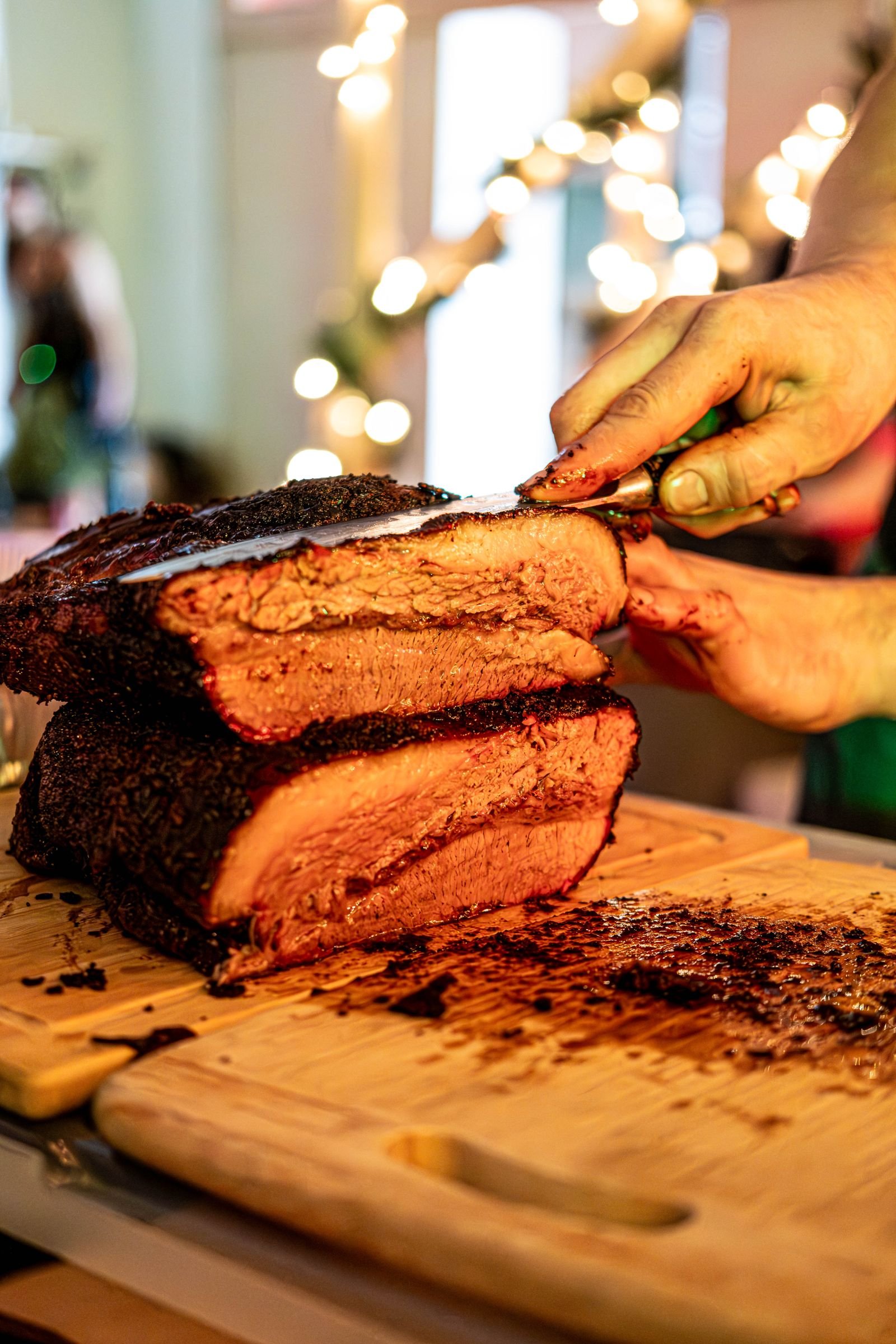
From here the target is a range, 200 to 207F, read in the thickest part of the flat and never in the point, where fat pockets read high and lie to you. Start probing at 198F. Slide a thin probe or a Thermapen tip into the flat in four places. It is done when the probe meets no grab at all going in or coming out, like pushing into softened butter, and when a lift under the middle makes the whole slab wobble. If it still grips at 203F, keep cooking. Collagen converts to gelatin on its own schedule.
8. Hold in a cooler until 150 to 155F
Take the wrapped brisket off and vent it on a wood board for 15 minutes to stop the climb, then wrap it in a clean cotton towel and set it in an empty insulated cooler. This is not about keeping dinner warm. The meat leaves the pit near 205F, carryover pushes it a few degrees higher, and the long slow fall from there down through 170F is extra collagen conversion you cannot buy any other way. At the same time the muscle fibers cool below the point where they are squeezing, so the rendered fat and gelatin pooled in the paper get drawn back into the meat instead of running onto your board. Hold 2 to 4 hours, until the center reads 150 to 155F. The paper and the towel keep hot meat off the plastic shell.
9. Separate the muscles and slice
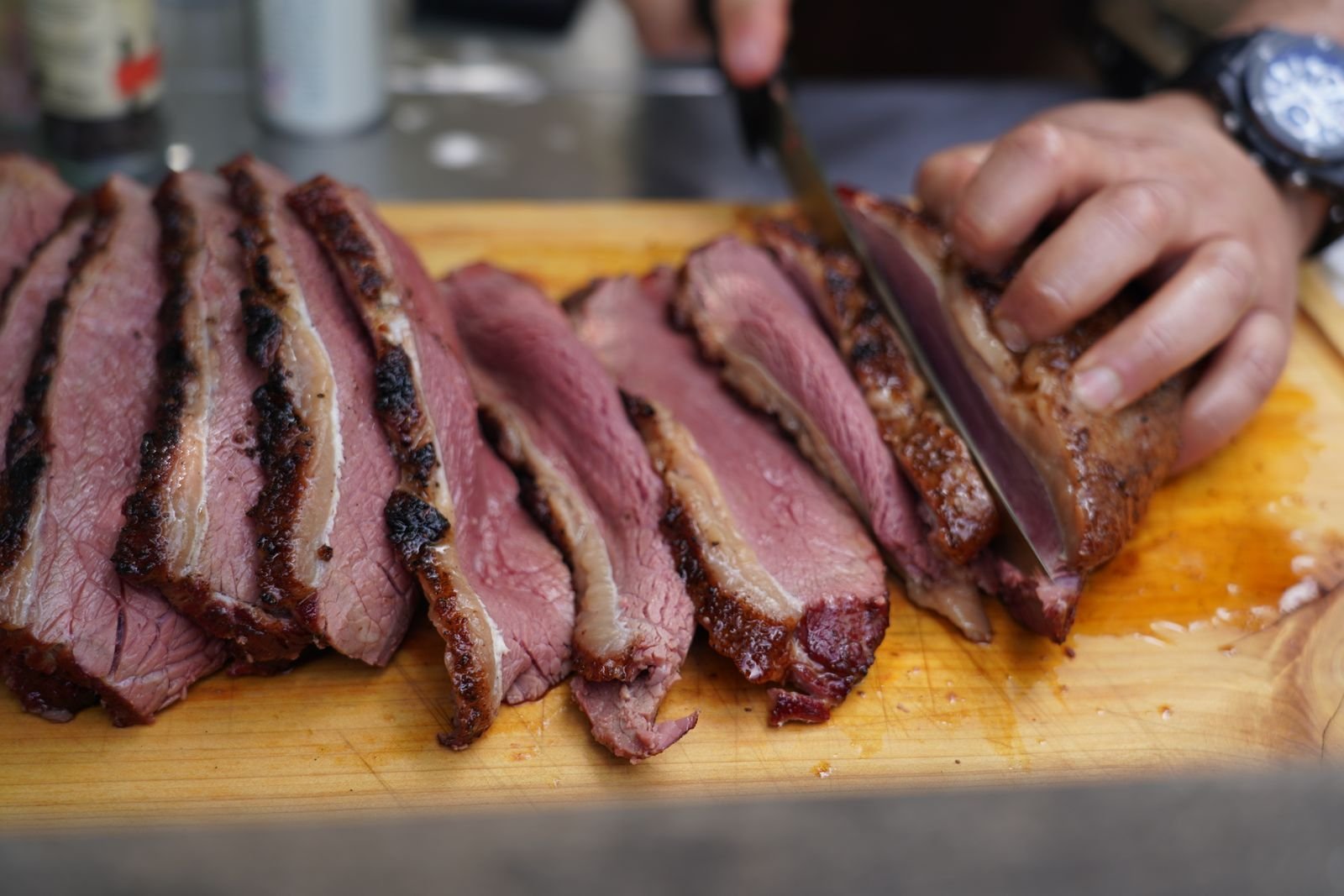
Unwrap over a tray and keep the juices. Find the fat seam and lift the point off the flat with your hands and a short knife. The two muscles run their grain in different directions, which is why one straight cut across a whole packer leaves half the slices chewy. Slice the flat against its grain at about the thickness of a pencil. Turn the point 90 degrees and slice it the same way, or cube it and crisp the cubes in cast iron for burnt ends. Pour the saved juices over the slices and serve within the hour.
Probe tender, and what 203F actually tells you
Temperature is a proxy. What you actually want is collagen turned to gelatin, and that conversion depends on time held above roughly 160F as much as on the peak number you reach. A brisket from an older animal has more collagen and more of it cross linked, so it needs longer at temperature even though the thermometer reads the same. Two packers can both say 203F while one is ready and one has twenty minutes left.
So use the number to tell you when to start checking, and use your hands to decide. Probe in at least four spots across the flat. Any spot that resists is connective tissue that has not given up yet, and the fix is always the same: close the lid, wait 20 minutes, check again. We would rather see 207F and no resistance than 202F and a grab.
Two practical notes. Your pit thermometer is probably wrong by 15 to 25 degrees, so verify it with an instant read; our meat thermometer buying guide covers which ones hold calibration. And if the probe slides in like butter at 196F, your brisket is done early, which happens. Pull it. There is no prize for hitting a number.
Why coffee and coarse black pepper build a better bark
Bark is a crust of dried rub, rendered fat, smoke compounds, and Maillard browning products bonded to the dehydrated meat surface. It needs three things to form well: a dry exterior, something with body to build on, and heat held long enough for browning reactions to run.
Ground coffee contributes to all three. Most of what is in your grinder is insoluble cell wall material, which means it behaves like a coarse dark spice rather than dissolving away. It brings its own roasted melanoidins, the same class of brown pigments and bitter aromatics that form on the meat surface, so instead of sitting on top of the bark it reinforces what the fire is already doing. The bitterness is the point. Beef fat is rich and faintly sweet, and bitter is the flavor that keeps slice number six as interesting as slice number one. Keep the grind fine so it coats evenly, and keep it under 3 tablespoons for a full packer or it tips from roasted to ashy.
The pepper is a texture decision. At 16 mesh the grains are large enough to stay physically distinct through the wrap and the hold, so you get a crust with grit to it rather than a smooth shell. Fine ground pepper dissolves into the fat and disappears. Crack it yourself the morning of the cook, because pre ground pepper has already lost most of its piperine volatiles to the jar.
Grass fed and pasture raised brisket is a different cook
A grass fed packer is not the same animal, and the recipes that ignore this are the reason people conclude grass fed beef is tough. It carries less intramuscular fat, the fat cap is thinner, and that fat is yellow rather than white because of carotenoids from forage. It also renders at a slightly different temperature and gives up far less liquid along the way.
Five adjustments, and they matter together rather than individually. Trim the fat cap to 3/8 inch instead of 1/4, since you have less to spare. Run the pit at 235 to 250F and resist the urge to go hotter, because there is no fat reservoir to protect the flat. Wrap earlier, at 155 to 160F, as soon as the bark passes the fingernail test. Double the tallow in the wrap to 4 tablespoons. And pull at the lower end of the window, 198 to 203F, the moment the probe stops grabbing.
Expect the whole cook to run 1 to 2 hours shorter than a grain finished packer of the same weight, and expect a shorter stall, because there is less moisture to evaporate. Hold for 2 hours rather than 4, since a leaner brisket cools faster and keeps giving up moisture the longer it sits. Slice it thinner too. If you are sourcing this way, our farmer directory is the place to start.
Pro tips and common mistakes
- Mark the grain before you cook. Cut a shallow notch along the grain of the raw flat. After 11 hours the bark hides the grain completely, and this is the single cheapest insurance against slicing it wrong.
- Stop opening the lid. Every look costs 10 to 15 minutes of recovery. The first 3 hours need nothing from you at all.
- Use wood and metal around hot fat. A wood board, metal tongs, a metal mixing bowl, a cast iron pan for rendering. Heat plus fat pulls microplastics out of plastic tools and containers, and brisket involves a great deal of both. Butcher paper is the honest exception here, and it is paper rather than plastic. The cooler is plastic, which is why the brisket goes in wrapped in paper and a cotton towel.
- Do not trust the point for temperature. Fat pockets conduct heat faster than muscle and will read 10F high. Probe the flat, in the thickest section, nearest the point.
- Build in four spare hours. Briskets finish when they finish. A cook that runs long cannot be hurried, but a cook that runs early holds happily in the cooler. Our broader smoking techniques guide has more on planning long cooks.
Troubleshooting
- Tough even though it hit 203F. Cause: pulled on temperature while collagen was still intact, or held for less than an hour. Fix: there is no rescue after slicing, so next time probe in four places and extend the hold to a minimum of 2 hours.
- Flat is dry, point is fine. Cause: pit running hotter than the gauge says, a flat thinner than 1 inch at the end, or slices cut long before serving. Fix: verify pit temperature with a second thermometer, round off thin corners during trimming, and slice only what goes on the table now.
- Bark is soft and pasty. Cause: wrapped before the bark set, too much spritz, or foil instead of paper. Fix: wait for the fingernail test, spritz lightly and no more often than every 45 minutes, and switch to unwaxed butcher paper.
- Temperature stuck at 160F for four hours. Cause: the stall, made worse by a dry pit with no water pan. Fix: wrap. The stall is evaporation, and wrapping is the only thing that stops it.
- Slices fall apart into shreds. Cause: cooked past 210F, or sliced while still above 160F. Fix: pull at probe tender in the 200 to 207F window and let the hold bring the center down to 150 to 155F before the knife goes near it.
Storage and leftovers
Store it whole or in large chunks, never pre sliced, because every cut face is a surface that dries. Wrap tightly and refrigerate up to 4 days. Pour any collected juices over the meat first, since that gelatin sets into a jelly in the cold and protects it. For longer storage, portion into meal sized pieces, cover each with a spoonful of juice, and freeze up to 3 months in metal or glass.
Reheat gently. Put the portion in a covered metal dish with 2 tablespoons of stock per pound and warm it at 300F until the center reaches 150F, usually 25 to 40 minutes. Chopped leftovers go into hash in a cast iron pan, into tacos, or into a pot of beans an hour before serving.
What to serve with it
- Pinto beans cooked with the trim. Simmer them under the brisket for the first few hours so the drippings land in the pot, then finish with onion, garlic, and cumin.
- Sharp vinegar slaw. No mayonnaise. Cabbage, cider vinegar, a little sugar, and plenty of black pepper, cutting straight through the fat.
- White bread and raw onion. The traditional Texas plate for a reason. Soft bread catches the juice and raw onion resets your palate between slices.
- A second smoked beef cut for a crowd. Our smoked beef short ribs with gochujang glaze run on a similar schedule and give the table something sweeter and sharper alongside.
Nutrition
About 640 calories, 52g protein, 46g fat, and 2g carbs per serving, based on 12 servings. These are estimates and vary with how hard you trim, the grade and finishing of the animal, and how much bark and fatty point ends up on each plate.
Frequently asked questions
Why was my brisket tough at 203F?
Because 203F is a time and temperature proxy for collagen conversion, not a guarantee of it. Older animals and leaner briskets carry more cross linked collagen and need longer above 160F to break it down. The probe test is the real answer: if it grabs anywhere in the flat, it is not finished, whatever the display says. Keep cooking in 20 minute increments.
How long can brisket safely hold in a cooler?
As long as the center stays above 140F, which a well insulated cooler will manage for 4 to 6 hours with a hot 12 pound packer. Below 140F you are in the range where bacteria multiply, so once the center drops to 150F you have maybe an hour of margin before you should serve it or refrigerate it. Preheat the cooler with hot tap water and dump it before the brisket goes in, and use a probe to track the actual temperature rather than guessing.
Can I smoke just a brisket flat?
Yes, with adjustments. A flat has no point beside it absorbing heat and no seam fat to render into it, so run the pit at 235F, wrap at 155F, and target the bottom of the window at 198 to 202F. Buy the thickest flat available, at least 6 pounds, and plan on roughly 45 minutes per pound. The result is good, but it will never be as forgiving as a packer.
Does the smoke ring mean anything?
Only aesthetically. The pink ring is nitric oxide from combustion gases reacting with myoglobin near the surface, and it stops forming once the exterior passes about 140F. It tells you nothing about smoke flavor, tenderness, or juiciness. You can produce one with curing salt and no smoke at all, and you can cook a wonderful brisket in an electric smoker with barely any ring.
Is grass fed brisket worth smoking?
It is, provided you cook it as its own thing rather than as a leaner version of grain finished beef. The flavor is more mineral and more distinctly beefy, and the bark takes on a deeper color. Follow the five adjustments in the grass fed section above, accept that you will get fewer burnt ends from a smaller point, and pull it earlier than instinct suggests.
Where to buy brisket worth 12 hours of your time
The supermarket packer is a lottery. You cannot see the grade label on a cryovac bag under fluorescent light, you cannot ask how the animal was finished, and you cannot request a thicker flat. A butcher or a farm can answer all three, and a brisket is the cut where those answers show up most plainly on the plate, because there is nowhere for a poor animal to hide across eleven hours of heat.
Use our Find a Farmer directory to locate producers selling beef near you, and ask for a whole untrimmed packer, 12 to 14 pounds, from an animal under 30 months. Tell them it is going on a smoker. Most will set aside a flexible one with an even flat, which is the single thing you cannot fix later with technique.