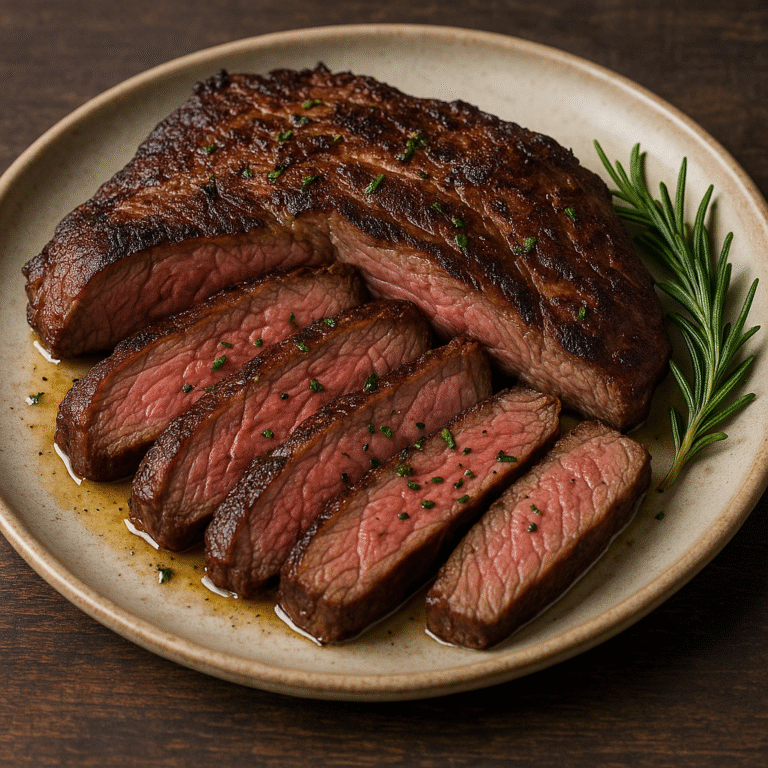
Beef Bourguignon with Porcini (Braised to Temperature)
Most beef bourguignon recipes tell you to use “chuck roast” and leave it there. That is the single decision that makes or breaks the pot, and it deserves more than two words. Chuck is a primal, not a cut, and the piece your butcher hands you could be chuck roll, shoulder clod or chuck eye, each of which behaves differently over three hours in wine. We have made this with all three. One of them is clearly best.
The other thing nobody tells you is when it is done. Every recipe says “until tender”, which is not a measurement. We cook this to a temperature, and we have put that number below. If you own a thermometer, this recipe gets easier and more repeatable than any version you have followed before.
Our addition is half an ounce of dried porcini, bloomed into the flour. It does not make the stew taste of mushroom. It makes the sauce taste like it simmered twice as long.
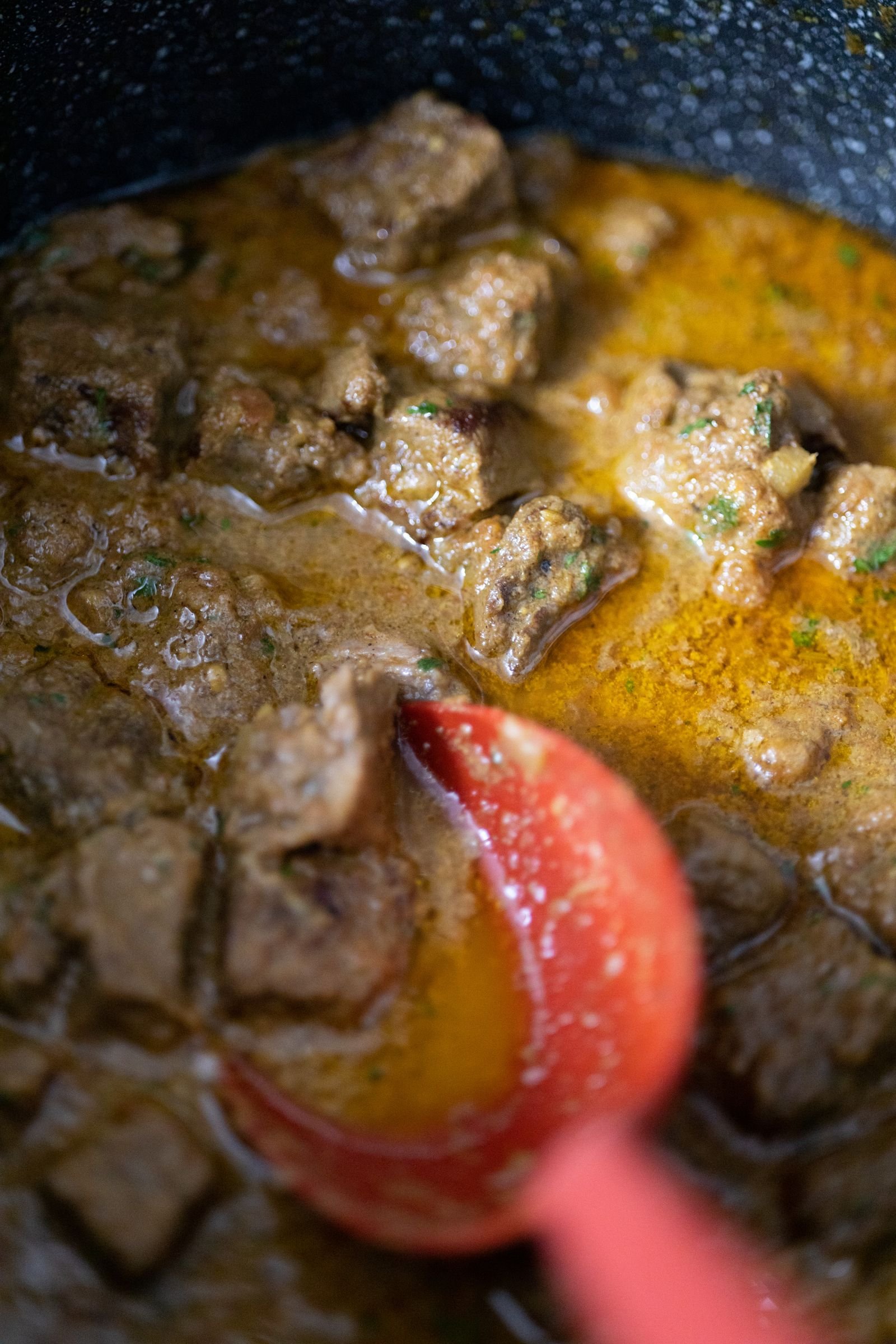
Why this recipe works
- We name the exact cut of chuck to ask for, and what happens if you use the wrong one.
- Doneness is a temperature, 195 to 205F, not a guess. Collagen converts to gelatin in that window and nowhere below it.
- Dried porcini bloomed with the flour adds savoury depth without a mushroom flavour taking over.
- The pearl onions and mushrooms are cooked separately so they stay whole and keep their own texture.
- The overnight rest is treated as a technique, not a convenience, because it is how you get the fat off cleanly.
Which cut of chuck to buy
Ask for chuck roll, cut into 2 inch cubes from a whole piece rather than bought as pre-cut stew meat. Pre-cut cubes are trimmed irregularly, usually smaller than you want, and often come from several different muscles with different cooking times in the same tray.
Shoulder clod is the common alternative and it is fine, just leaner, so check it 30 minutes earlier. Chuck eye roll is richer and excellent but costs more than this dish needs. What you should not use is anything from the round. Those cuts are lean by design and have very little connective tissue, so there is nothing in them to turn to gelatin. They go from firm to dry with no tender stage in between.
If you are buying from a farm share or a bulk box, the chuck is usually the most abundant braising cut you will have, which makes this a good recipe to learn properly. Our guide to beef cuts shows where each of these sits on the animal.
Ingredients
For the braise
- 3 lb (1.4 kg) beef chuck roll, trimmed, cut into 2 inch cubes
- 6 oz (170 g) thick cut bacon, diced
- 2 tsp kosher salt, plus more to finish
- 1/2 tsp freshly ground black pepper
- 1 large yellow onion, diced
- 1 medium carrot, cut into 1/2 inch rounds
- 3 cloves garlic, minced
- 1 tbsp tomato paste
- 1/2 oz (15 g) dried porcini, finely chopped
- 3 tbsp all purpose flour
- 1 bottle (750 ml) dry red wine, pinot noir or a similar light tannin red
- 1 cup (240 ml) beef stock
- 5 sprigs fresh thyme and 2 bay leaves
For finishing
- 3 tbsp unsalted butter
- 8 oz (225 g) pearl onions, peeled, fresh or frozen
- 8 oz (225 g) cremini mushrooms, quartered
- 2 tbsp chopped flat leaf parsley
Substitutions. No porcini: add another tablespoon of tomato paste and a splash of Worcestershire at the end. No pearl onions: halved shallots work. No bacon: use 2 tbsp of beef tallow or olive oil, and add 1/2 tsp of smoked paprika with the tomato paste.
How to make beef bourguignon
1. Dry the beef and season it
Pat 3 lb of chuck cubes dry with paper towels, then season with 2 tsp kosher salt and 1/2 tsp black pepper. Wet beef steams instead of browning, and the crust you build here is most of the finished flavour.
2. Render the bacon
Cook 6 oz of diced bacon in a Dutch oven over medium heat for 10 minutes until the fat has rendered and the pieces are crisp. Lift the bacon out with a slotted spoon and leave every drop of fat behind.
3. Brown the beef in batches
Sear the beef in the bacon fat in two or three batches, 2 to 3 minutes a side, until deeply browned. Crowding the pan drops the temperature and you get grey meat. This is the step people rush and regret.
4. Soften the aromatics
Add 1 diced onion and 1 sliced carrot to the fat and cook 4 minutes. Add 3 cloves of minced garlic for 30 seconds, then 1 tbsp tomato paste and cook 2 minutes until it darkens from red to brick.
5. Bloom the porcini and dust with flour
Stir in 1/2 oz of dried porcini, finely chopped, with 3 tbsp flour. Cook 1 minute. The porcini is our addition and it is the reason this tastes deeper than the version you have had before.
6. Deglaze and braise
Pour in a 750 ml bottle of dry red wine, scraping the base clean, then 1 cup beef stock, 5 thyme sprigs and 2 bay leaves. Return the beef and bacon, bring to a simmer, cover and move to a 325F oven for 2 hours 30 minutes.
7. Check with a thermometer, not a clock
Pull a cube and probe the centre. You want 195 to 205F, where collagen has turned to gelatin. Under 190F it will still be chewy no matter how long the recipe said.
8. Brown the onions and mushrooms separately
Melt 3 tbsp butter in a skillet and cook 8 oz pearl onions and 8 oz quartered cremini for 12 to 15 minutes until browned. Cooking them apart keeps them whole and gives two textures instead of one.
9. Rest it overnight, then finish
Cool and refrigerate overnight. Lift the solid fat off the top the next day, reheat gently, fold in the onions and mushrooms, and finish with parsley.
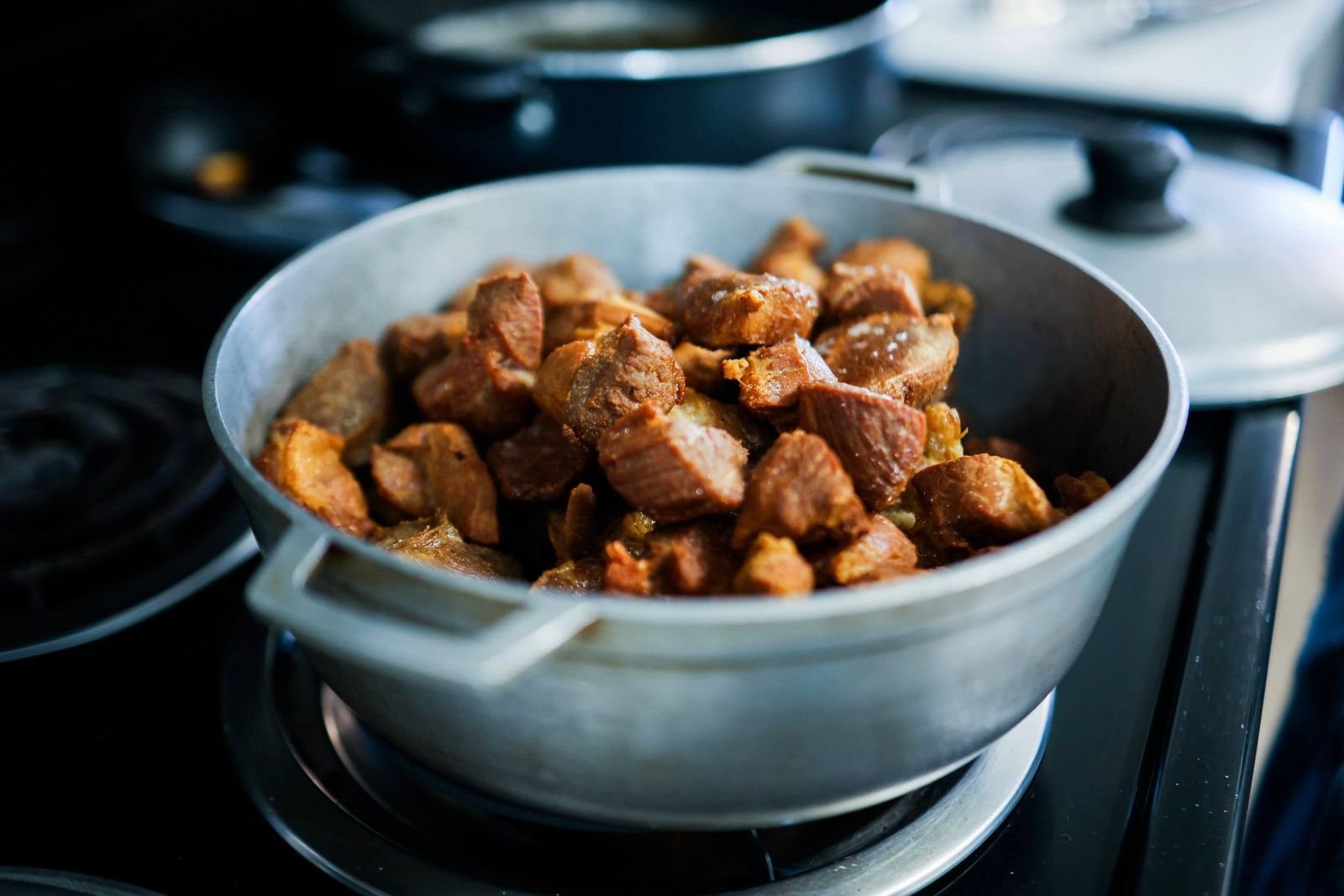
The temperature nobody mentions
Braising is often described as a time, which is why so many people end up with tough stew and no idea why. What is actually happening is a conversion. Collagen in the connective tissue breaks down into gelatin, and that reaction runs usefully from about 160F upward but only gets fast in the 190s. Below 190F internal you can braise for five hours and still be chewing.
So we treat the two and a half hours as an estimate and the thermometer as the answer. Pull one cube out at the two hour mark, probe the centre with an instant read, and keep going until it sits between 195 and 205F and a fork twists in it with no resistance. A grass finished chuck often needs an extra 20 to 30 minutes, which brings us to the next point.
If your beef is grass fed
Grass finished and pasture raised chuck is usually leaner than grain finished, with firmer connective tissue and less marbling to baste it from the inside. Two adjustments help. Drop the oven to 300F so the outside of each cube does not dry out while the centre catches up, and expect to add 30 to 45 minutes. Check the liquid at the 90 minute mark and add half a cup of water if the sauce is tightening onto the base of the pot.
This is worth knowing because the beef most people buy direct from a farm is grass finished, and following a recipe written for commodity chuck is the usual reason it disappoints.
Pro tips and common mistakes
- Crowding the pan. Two or three batches, always. The sear is flavour, and steamed beef cannot be fixed later.
- Underseasoning the braise. Season the beef before searing, not the sauce at the end. Salt added late sits on top rather than through.
- Boiling instead of braising. A hard simmer tightens muscle fibre and squeezes out moisture. You want the surface barely moving, which is why the oven is steadier than the stove.
- Skipping the fat skim. An unskimmed bourguignon tastes heavy and coats your mouth. Chill it and lift the cap off.
- Cooking the garnish in the pot. Pearl onions and mushrooms added early collapse into the sauce. Cook them in butter and fold them in at the end.
Troubleshooting
- Beef still tough. Internal temperature too low. Cover and keep going, checking every 20 minutes until 195F.
- Sauce too thin. Strain the solids out, reduce the liquid over medium high heat until it coats a spoon, then recombine.
- Sauce too thick or catching. Add half a cup of water or stock and stir the base clean.
- Tastes sharp or sour. The wine has not reduced enough. Simmer uncovered for 10 minutes and add a teaspoon of honey if it is still biting.
- Tastes flat. Salt first, then a splash of vinegar. Flat usually means underseasoned rather than underflavoured.
Storage and leftovers
Bourguignon keeps in the refrigerator for 4 days in a sealed container and freezes well for 3 months. Reheat gently on the stove over medium low, adding a splash of water if the sauce has tightened. Do not reheat it hard: the beef is already fully cooked and a rolling boil will dry the cubes out. Leftovers are very good over buttered pappardelle, or folded into a pie with a sheet of puff pastry over the top.
What to serve with it
- Mashed potato, loose rather than stiff, so the sauce runs into it.
- Buttered egg noodles, the quickest option and the one we use on a weeknight.
- Crusty bread and nothing else, which is how it is most often eaten in France.
- A sharp green salad with a mustard vinaigrette, to cut the richness.
Nutrition
About 700 calories, 58g protein, 42g fat, and 10g carbs per serving, based on 6 servings. These are estimates and vary with the exact cut, how much fat you skim, and any substitutions.
Frequently asked questions
What cut of beef is best for bourguignon?
Chuck, and specifically the chuck roll. It carries enough intramuscular fat and connective tissue to survive three hours and come out silky. Shoulder clod works but is leaner and can go stringy. Avoid anything from the round: eye of round and top round have almost no collagen and will turn to sawdust in a braise.
Why is my beef still tough after three hours?
It has not reached the temperature where collagen converts. Tough is not an argument for more salt or more wine, it is an argument for more time. Probe a cube: if it is under 190F internally, cover it and give it another 30 to 45 minutes.
Does the wine really have to be good?
It has to be drinkable. Wine reduces by more than half here, so every flaw concentrates. A corked or oxidised bottle will ruin the pot. A sound 12 dollar pinot noir beats a tired 40 dollar bottle every time.
Can I make it without the porcini?
Yes, and it will still be good. The dried porcini adds glutamates that make the sauce taste more savoury without tasting of mushroom. If you skip it, add an extra tablespoon of tomato paste and a splash of soy or Worcestershire at the end.
Is it really better the next day?
Yes, for two reasons people rarely separate. The flavours do settle, but the bigger gain is practical: chilling solidifies the fat so you can lift it off in one sheet instead of chasing it with a spoon.
Where to buy the beef
Chuck is the cut that rewards buying well, because you are tasting the beef itself for three hours rather than covering it in a sauce. If you want grass finished or pasture raised chuck from someone who can tell you how the animal was raised, our Find a Farmer directory lists beef farmers selling direct across the country. A quarter or half animal will give you more chuck than any other braising cut, which makes this recipe a useful one to have down.
More on the method in our guide to braising meat. If you like this, try our porcini and red wine beef pot roast or the coffee and cocoa braised beef chuck, both built on the same cut.